
Biophilic Office Design: How Furniture Materials and Shapes Can Mimic Nature
- 12 Oct, 2026
- Guides
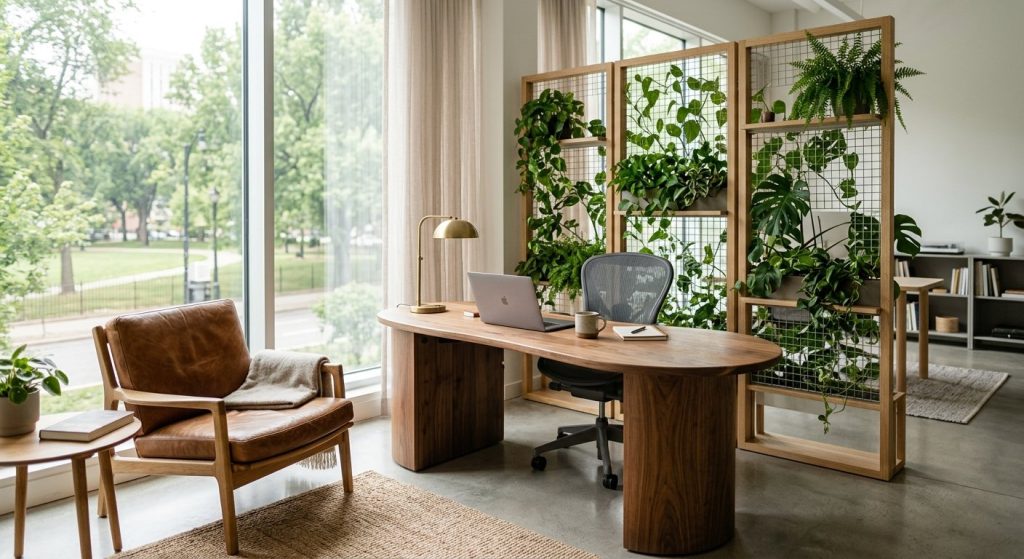
Biophilic office furniture mimics nature through three concrete levers: materials (real wood grain, stone, woven natural fibers), shapes (organic curves instead of hard rectangles, asymmetry, rounded edges), and integration (furniture that frames or holds greenery and natural light). The furniture matters more than the potted plants in the corner because it’s what employees touch and sit in through most of the workday. Get the furniture layer right and the plants become a bonus, not the whole strategy.
Key takeaways
- Biophilic furniture must pass three tests at once: genuinely natural material, organic shape, and active integration with light or plants, not decoration alone.
- Real wood, leather, natural stone and woven natural fiber qualify as biophilic materials; printed laminate and synthetic mesh are imitations even when they look convincing in photos.
- Live-edge tables and curved lounge seating like Vision’s SOFA ONE, PIG, and MOUNTAIN work best in reception or breakout zones, not dense open-plan desk grids.
- Hard natural surfaces reflect sound, so pair stone and solid wood with soft upholstered biophilic elements to avoid making an open-plan office noisier.
- Ask suppliers whether a finish is solid material or veneer over E1-grade board, and confirm what the warranty covers before committing to a material you expect to last for years.
What Biophilic Design Actually Means for Furniture (Not Just Plants)
Biophilia is the term biologist E.O. Wilson popularized for humans’ innate pull toward nature: we relax around natural patterns because our nervous systems evolved reading forests, water and sky, not drywall and fluorescent tubes. That’s the background. It explains why the concept works, but it doesn’t tell a buyer what to put on the purchase order.
For furniture, biophilic means three things have to be true at once: the material has to be natural or genuinely natural-derived, the form has to echo organic shapes rather than rigid geometry, and the piece has to actively support nature-related function, like letting daylight through or holding a plant properly instead of just standing near one. Miss any of the three and you’ve got decoration, not biophilic design.
Biophilic vs. Biomorphic vs. Skeuomorphic
A chair shaped like a leaf but molded from glossy plastic is biomorphic, not biophilic. It copies a form without any of the material or sensory connection to nature. Skeuomorphic is worse: a laminate desk printed with a photo of wood grain that’s flat and cool to the touch isn’t fooling anyone’s nervous system. True biophilic furniture passes a simple test: does it look, feel, and function like something from the natural world, not just resemble one in a catalog photo?
The rest of this guide treats biophilic furniture as a sourcing decision, not a mood board. If you’re also weighing broader workplace direction, our overview of the evolution of office furniture toward well-being is a useful companion read.

Why Nature-Inspired Furniture Affects Mood and Focus: The Mechanism, Not a ‘Studies Show’ Claim
Wood grain, stone veining and woven fiber all contain fractal patterns: irregular detail that repeats at different scales, the same structural logic you see in tree branches or coastlines. One plausible explanation for why these surfaces feel calming is that the eye doesn’t have to work as hard to parse an irregular, naturally repeating pattern as it does to parse a flat, uniform synthetic surface, which is why a grained wood panel can read as calmer than a sheet of glossy white plastic even though both are just surfaces in a room.
Natural materials also regulate more than vision. Wood and woven fiber have thermal mass and texture that feel warmer to the touch than metal or hard plastic, and soft organic materials like cork, cane and upholstered wood frames absorb sound rather than bouncing it, which matters a lot in an open-plan office full of hard desks and glass partitions.
Light-colored, daylight-permeable natural finishes also reduce how hard overhead fixtures have to work. A pale ash or oak desk surface bounces window light around a room instead of absorbing it the way a dark laminate does, which cuts down on the contrast your eyes are constantly adjusting to. None of this requires an invented productivity percentage to be worth acting on: it’s basic physics of light reflection and material texture, and it’s reason enough to prioritize real materials over printed imitations.
Materials That Qualify as Biophilic (And the Imitations That Don’t)
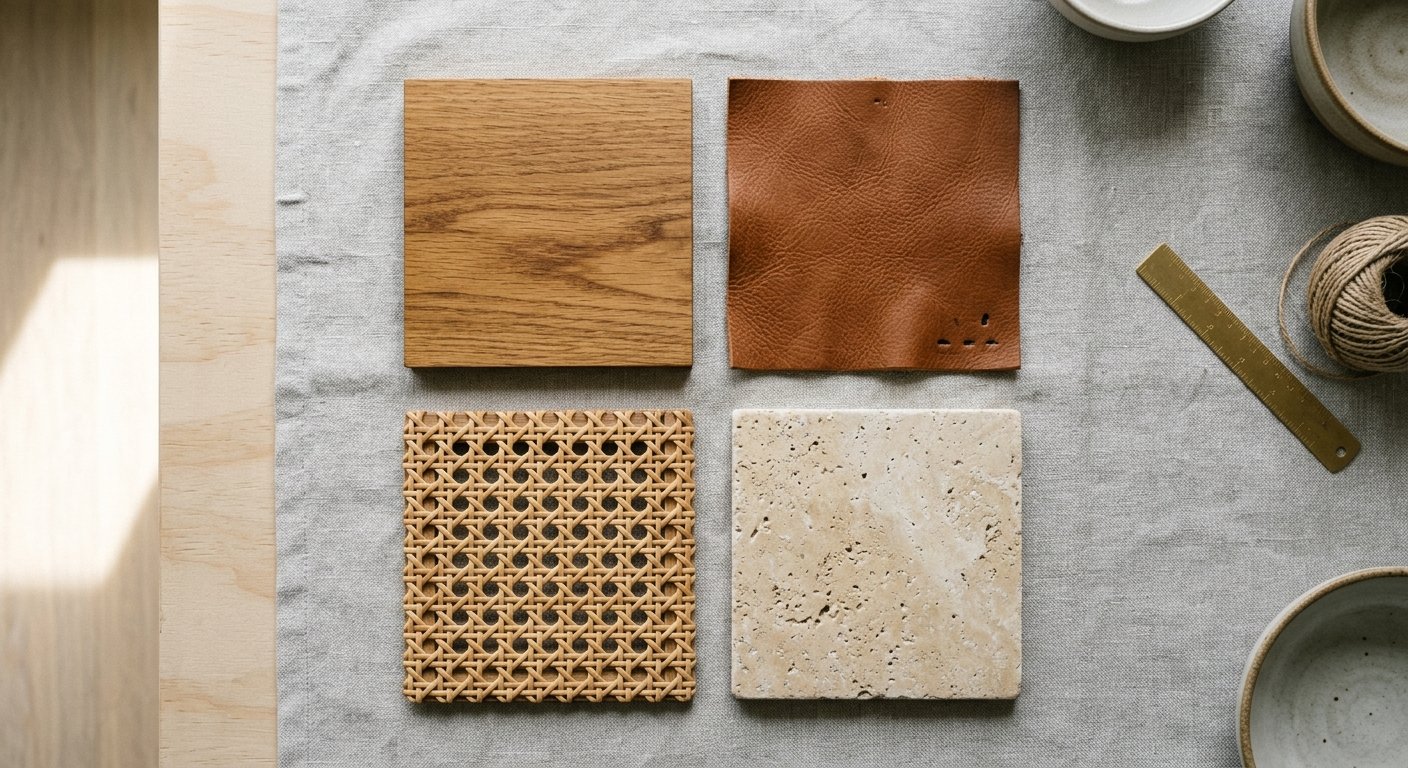
- Real wood vs. wood-grain laminate: Solid wood or genuine veneer shows grain variation you can feel under your fingers; printed laminate repeats the same pattern every few feet. Laminate on an E1-grade substrate is a legitimate commercial-grade compromise for high-traffic desks where real wood would scratch too fast, but it shouldn’t be marketed as the biophilic anchor piece in a room.
- Natural stone and stone-look composite: Marble, granite or quartzite reception counters carry genuine mineral veining. Stone-look composite surfaces are acceptable for durability in high-touch counters, but save the real thing for a lobby statement piece where buyers and visitors actually touch it.
- Woven natural fibers: Rattan, cane and jute on chair backs or sofa accents bring texture synthetic mesh can’t replicate, though they demand different placement than synthetic weaves (more on that under durability below).
- Leather and leather-alternative upholstery: Leather is itself a natural material with grain variation piece to piece. Vision’s Ferine, Trivaro and Sovante are examples of office chairs upholstered in leather, giving buyers a tactile natural-material option for task seating rather than only synthetic mesh or fabric.
- FSC-certified wood: Ask any supplier whether their wood options carry FSC certification. It’s a credential, not a marketing word, and it tells you the timber was sourced under a tracked forestry standard.
- E1-grade board matters because most ‘natural wood’ furniture is engineered wood with a veneer on top. E1 is a formaldehyde emission standard for the board core. Ask your supplier directly which certification scope applies to the specific product line you’re buying: Vision, for instance, states that its hotel furniture collections meet ISO9001, E1-grade board, and FSC wood option standards, which is the kind of specification sheet a buyer should request before assuming ‘natural wood’ means solid lumber.
For a broader material breakdown beyond the biophilic lens, see our guide to office furniture materials.
Shapes That Mimic Nature: Curves, Asymmetry, and Why Rectangles Feel Unnatural
Nature almost never produces a perfect right angle. Rivers curve, leaves taper unevenly, rock faces fracture at irregular diagonals. A room full of grid-aligned rectangular desks is visually efficient but has none of that irregularity, which is exactly why a few curved edges and rounded corners register as calming relief rather than clutter.
Live-Edge Tables: Where They Work and Where They Don’t
A live-edge tabletop, one that keeps the natural irregular contour of the tree trunk it came from, is the boldest biophilic shape statement available. It’s excellent in a reception area or an executive office where there’s room to let the irregular footprint breathe. It’s a poor fit for dense open-plan layouts, where every inch of desk depth is budgeted and an irregular edge just wastes usable surface.
Organic Lounge Silhouettes
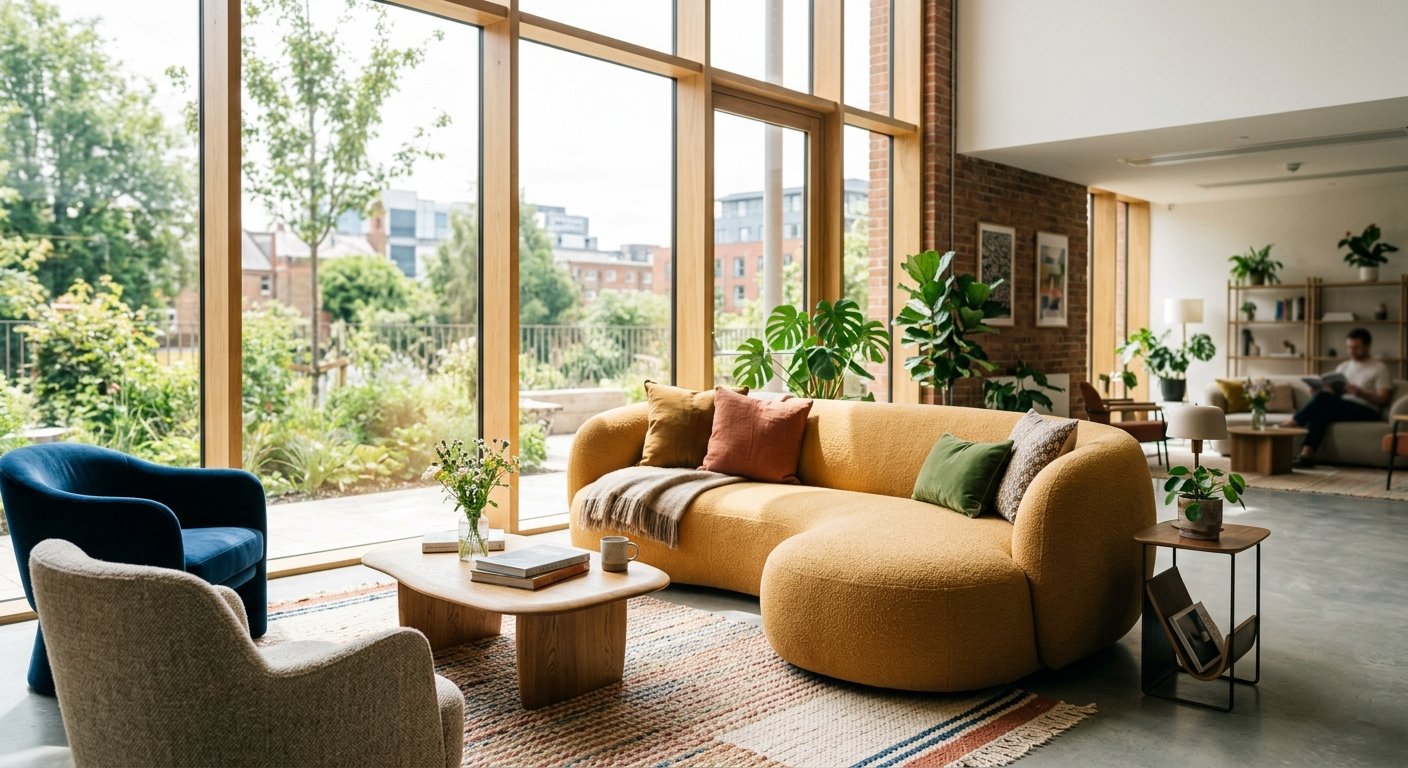
Rounded, non-rectangular lounge seating does the same job at a larger scale. Vision’s SOFA ONE, PIG, and MOUNTAIN lounge sofas are examples of organic, curved silhouettes suited to breakout zones and lobbies rather than formal rectangular boardroom furniture. Grouped asymmetrically, these pieces mimic the irregularity of a forest clearing rather than the formal grid of a traditional boardroom, and that asymmetry is itself a biophilic cue, not just a style choice.
Furniture That Integrates Plants and Light, Not Just Sits Near Them
A ficus in a floor pot next to a desk isn’t integration, it’s coexistence, and it gets knocked over, forgotten, or watered by whoever remembers last. Furniture designed to hold, frame, or route around greenery is the functional layer most biophilic checklists skip entirely.
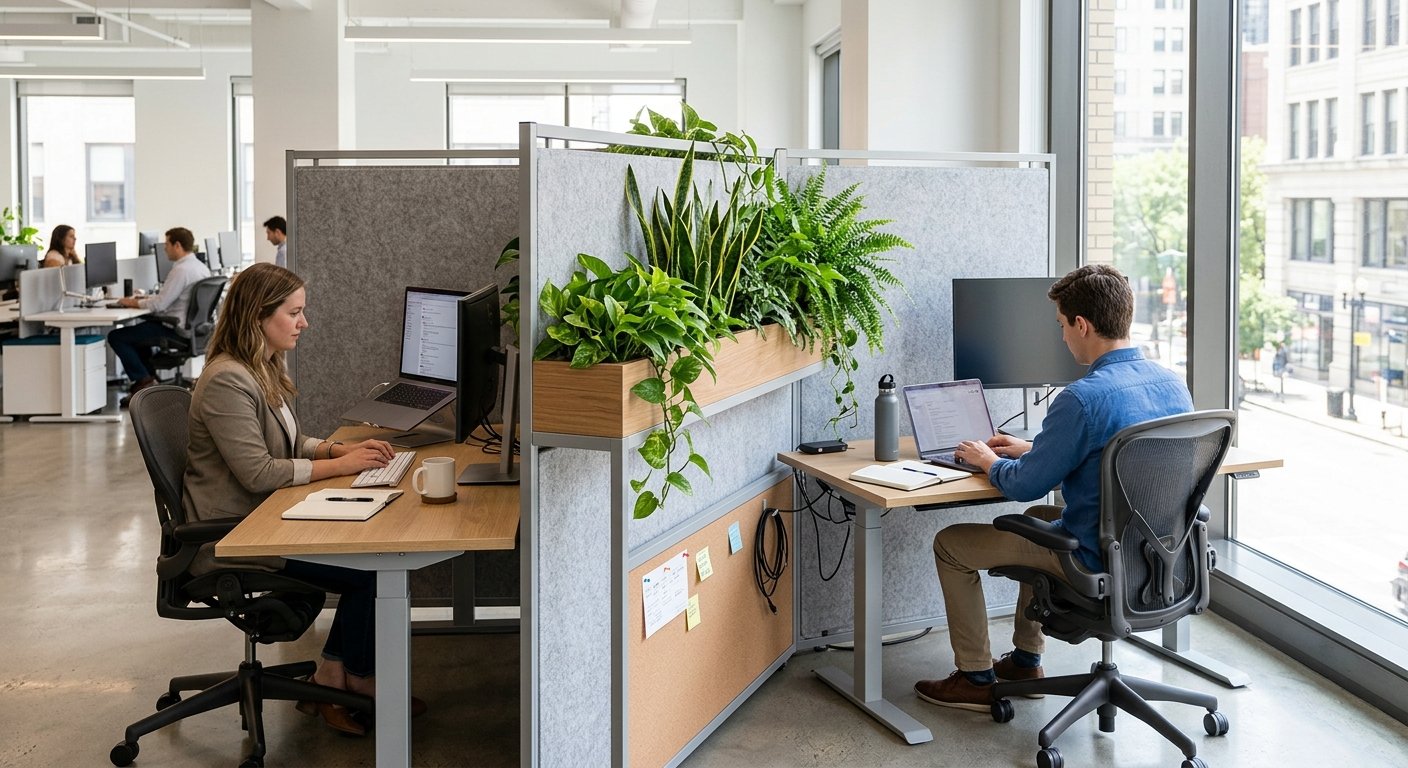
Modular desk dividers and screens with built-in planter troughs solve the knocked-over-pot problem by giving the plant a fixed, intentional spot between workstations instead of a floor gap. Vision’s MIX SCREEN and LOTUS accessories are examples of modular screening elements that can double as plant-integration points, separating desks for privacy while giving greenery a built-in home rather than an afterthought pot.
Low-profile furniture and glass or light-colored finishes matter just as much on the light side of the equation. A tall opaque filing cabinet wall blocks the daylight path from a window just as effectively as heavy drapes. When you’re planning a layout, check sightlines from desks that aren’t closest to the window, not just the ones that already get good light; that’s usually where the biophilic benefit is weakest and most worth fixing with lower furniture profiles.
Small Biophilic Office Furniture Design: Making It Work in Tight Spaces
- Pick one or two high-impact pieces instead of scattering small gestures: a live-edge meeting table or a woven-accent lounge chair does more for a small room than five tiny decorative touches spread thin.
- Use light natural finishes, not dark heavy wood: pale ash, bamboo or light oak visually expands a tight room, while dark walnut or mahogany closes it in no matter how authentic the grain is.
- Go vertical with plant integration: wall-mounted troughs on screens free up circulation space that floor-standing planters eat into, which matters a lot in a small conference room or narrow reception.
- Put visible texture at eye level: in a small room glanced at quickly, the piece closest to eye level, often a chair back or a tabletop edge, is what registers as ‘natural’ first. Spend the material budget there before the baseboards or legs.
If floor space is the real constraint rather than budget, our piece on space optimization for small workspaces pairs well with this list.
Durability Trade-Offs: Real Wood, Live Plants, and Moss Walls in Real Office Conditions
Real wood scratches, stains, and eventually needs refinishing, full stop. Wood-look laminate bonded to an E1-grade substrate trades some of that authentic feel for consistent commercial-grade wear resistance, which is a reasonable call for a desk that gets bumped and scraped daily rather than a showpiece table that gets admired, not abused.
Live plants need an ongoing care budget: watering, replacement, someone responsible. Preserved moss walls or quality artificial greenery panels are the lower-maintenance middle ground, but they lose the tactile and scent cues that make live plants feel genuinely alive. Neither choice is wrong, it depends on whether anyone on staff is actually going to water a dozen desk plants every week.
Woven natural fiber accents like rattan and cane fray faster under heavy daily hand contact than synthetic woven alternatives. Reserve real rattan or cane for lower-touch zones like lobby lounge seating rather than task chairs that get gripped and shifted dozens of times a day.
Whatever you choose, ask suppliers directly which ‘natural’ finishes are solid material versus a veneer over engineered board, and what the warranty actually covers for cracking, fading or delamination. Every order from Vision includes a warranty and spare-part support, which is the kind of backing worth confirming before you commit to a material that looks great in a showroom but has to hold up under years of real office traffic.
Balancing Biophilic Looks With Acoustics and Ergonomics in Open-Plan Offices
Hard natural surfaces like solid stone counters and bare solid wood tables reflect sound more than soft synthetic panels do, so an all-hard-surface biophilic room can actually make an open-plan office noisier, not calmer. Pair hard natural materials with soft biophilic elements, woven fiber panels, upholstered lounge seating, to keep the acoustic balance in check. For a deeper dive on this exact tension, see our guide on soundproofing an open office with furniture.
Organic-shaped screens and plant-integrated dividers can double as zoning and sound-absorbing tools, but only if the fill material inside them is acoustically rated, not just decorative fabric stretched over a frame. Ask what’s inside the screen before assuming it’s doing any acoustic work.
None of this should come at the cost of ergonomic basics. Live-edge and curved furniture is a finish layer on top of proper desk height, monitor positioning and lumbar support, not a substitute for them. For every biophilic piece you add, run a quick two-part check: what does it do to the room’s noise level, and does it still meet the ergonomic requirement of the task performed there? If a live-edge table looks stunning but seats people at the wrong height for laptop work, it’s failed the second half of that test regardless of how natural it looks.
Building Your Biophilic Furniture Shortlist: A Practical Next Step
Run every furniture option on your list through the same three-lever test: is the material genuinely natural, does the shape echo organic form, and does the piece actively integrate light or greenery rather than just sitting near it? Pieces that pass all three are worth the budget; pieces that pass one or two are fine as supporting players, not centerpieces.
Start with one anchor zone, a reception area or a breakout lounge, rather than retrofitting an entire floor at once. It’s easier to judge whether the material and maintenance trade-offs actually work for your team on a small scale before committing the whole budget.
Vision is a leading office furniture manufacturer in China offering OEM/ODM production, which means finishes, wood options, and screen or planter configurations can be customized to match a specific biophilic concept rather than forcing a catalog-only choice. With facilities in Foshan and Guangzhou and remote installation support, plus on-site installation workers when needed, sourcing leather seating, organic-shaped lounge sofas, and modular screen accessories for a biophilic layout is a conversation worth having early, not after the floor plan is locked in. If you’d like to talk through options, get in touch with Vision’s team or browse the full product range to see what’s available to customize.
Frequently asked questions
What furniture materials count as truly biophilic?
Real wood, natural stone, leather, and woven natural fibers like rattan, cane and jute count as biophilic because their texture and grain variation come from the material itself. Printed wood-grain laminate or synthetic woven mesh look similar from a distance but don’t carry the same tactile or visual complexity, so they’re imitations, not biophilic materials.
Are live plants necessary for biophilic office design?
No. Furniture material, shape and light integration carry most of the biophilic effect on their own. Live plants add a real benefit but require ongoing care; preserved moss walls or quality artificial greenery are a reasonable lower-maintenance substitute if staff can’t commit to regular plant upkeep.
Does biophilic furniture cost more than standard office furniture?
It depends on the material chosen. Solid wood, natural stone and real leather typically cost more than laminate or synthetic alternatives, but E1-grade engineered wood with genuine veneer offers a middle ground that keeps biophilic texture while controlling cost for high-traffic commercial use.


