
Office Phone Booth Buying Guide: Types, Acoustics, Sizes & Costs (2026)
- 19 Aug, 2026
- Guides
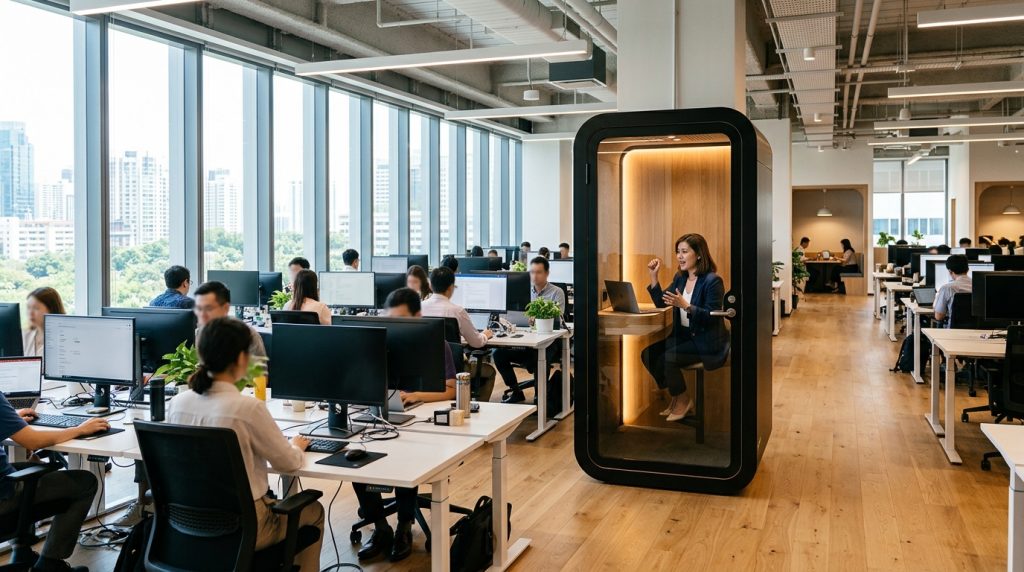
Walk through any open-plan office around 10am and you'll see the same scene: someone pacing the corridor with a phone pressed to their ear, someone else taking a video call from the stairwell, and a “quiet zone” that is anything but. Rows of open desks and workstations made offices cheaper and collaboration easier. They also made privacy nearly extinct. Surveys keep finding that over half of office workers consider their workplace too noisy, and hybrid work made it worse, because now every desk doubles as a video conferencing station.
The fix most companies land on is the office phone booth. Not walls, not more meeting rooms. A freestanding, sound-insulated pod you can drop onto the floor plan this month and move somewhere else next year.
We manufacture these booths, so we talk to buyers about them every week. This guide covers the questions that come up most: what types exist, which specs actually matter (and which are marketing), how much space to plan for, and what you should expect to pay.
What Is an Office Phone Booth?
An office phone booth — you'll also hear privacy pod, acoustic booth, or soundproof pod, they're all the same thing — is an enclosed unit for one person to take calls or video meetings without broadcasting them to the whole floor.
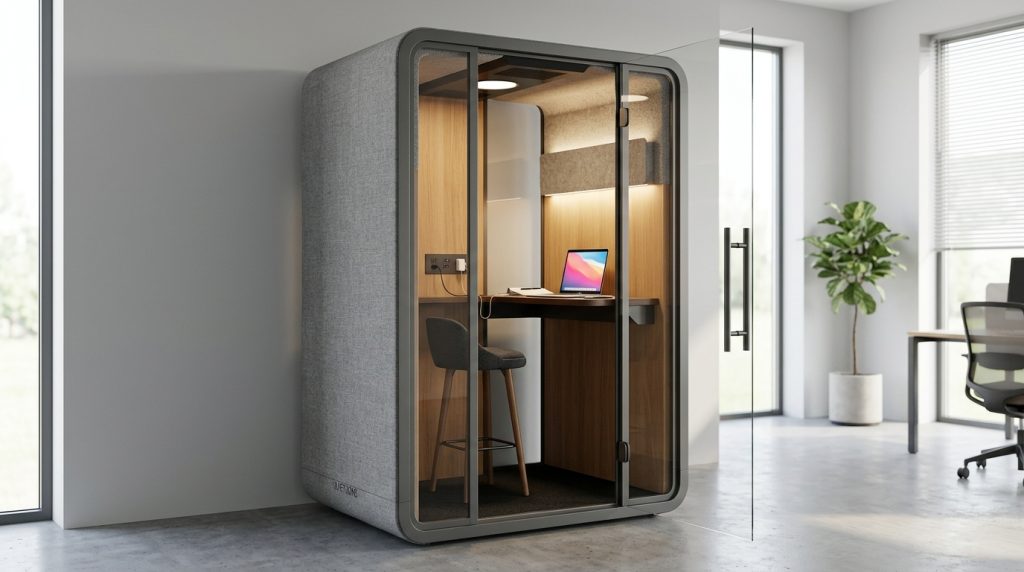
Open the door of a decent one and you'll find a sound-insulated shell with a proper acoustic door seal, a glass panel so it doesn't feel like a closet, sound-absorbing lining on the inside walls, a quiet ventilation fan, LED lighting, and power plus USB. Many add a small work surface for a laptop.
The key difference from building a real room: a booth is furniture. It ships in panels, goes up in a couple of hours, needs no permit, and moves when your layout does. That last point is why coworking operators and fast-growing companies buy booths instead of drywall.
Types of Office Phone Booths and Pods
“Phone booth” gets used loosely. In practice there are three formats, and buying the wrong one is a common (and expensive) mistake.
Solo phone booth (1 person)
The classic. Roughly one square meter of floor space, sized for a 20–40 minute call. Our UVO sits in this category — a compact acoustic shell with a clean profile that doesn't fight the rest of the interior.
Meeting pod (2–4 people)
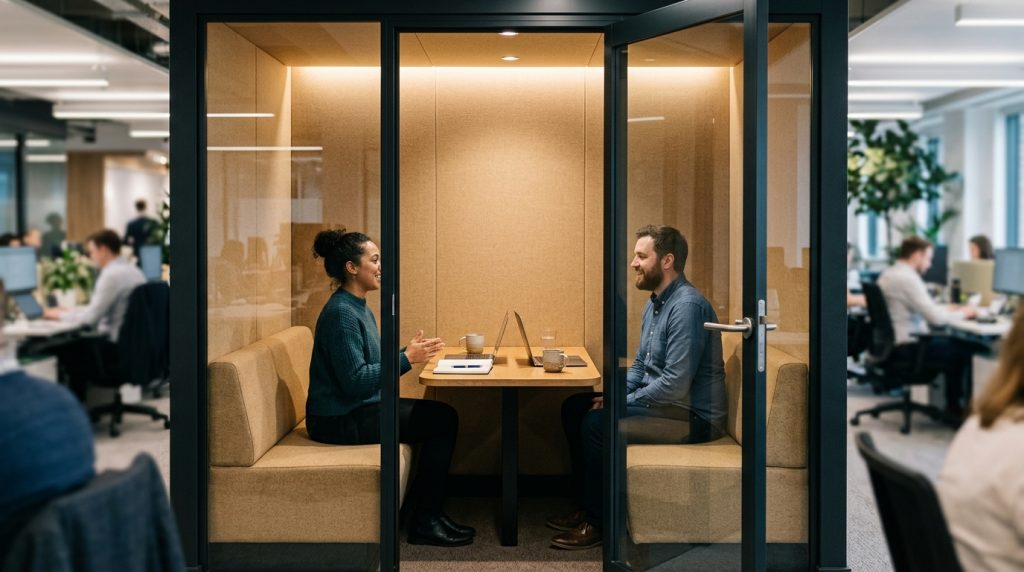
A bigger enclosed pod with bench seating and a table. Good for one-on-ones, interviews, quick huddles. In most offices we work with, the booked conference rooms are occupied all day by two-person conversations while the full meeting table sits empty around them. Meeting pods exist to absorb exactly those conversations.
Focus and work pods
Somewhere in between: room for one person to actually work for a few hours, with a full desk and a chair. Orvessa is a good example of this type of workspace, offering a more private setting for focused work when the problem isn't calls, it's concentration.
Which do you need? Simple test. If people are hunting for somewhere to talk, buy solo booths. If they're hunting for somewhere to meet, buy pods. Most offices end up with a mix. A rough starting ratio is one booth per 8–12 employees, but honestly, the better method is to spend a week counting how many private calls happen at the same time during your busiest hours. Buy for that peak, not for headcount.
What to Look For When Buying an Office Phone Booth
Here's the uncomfortable truth about this market: from the outside, a $2,500 booth and an $8,000 booth look almost identical. The differences are in things photos don't show. These five, in order of importance.
Acoustic performance
Ask for numbers, not adjectives. The standard that matters for pods is ISO 23351-1, which measures how much a booth reduces the level of speech escaping it. A properly built booth lands somewhere around 25–35 dB of speech level reduction — enough that a normal conversation inside turns into an unintelligible murmur a few meters away.
And be skeptical of the word “soundproof.” No booth is. What kills performance is never the walls; it's the weak points. Check the door gasket, how the shell meets the floor, the glass (laminated acoustic glass, not plain tempered), and whatever hole the cables pass through. One bad seal undoes everything else.
The interior lining matters too, for a different reason: without absorption inside, your own voice bounces around and you sound like you're calling from a tin can. The person inside notices this before anyone outside does.
Ventilation
An airtight box fills with CO₂ faster than people expect. After 15 minutes in a badly ventilated booth you'll feel it. A well-designed unit runs quiet fans continuously, exchanging the full air volume many times per hour without adding hum to your calls. If a supplier can't state their airflow figures, that usually means there's nothing worth stating. Occupancy sensors that ramp the fans up when someone enters are a nice touch, not a requirement.
Power, connectivity, lighting
Minimum: one mains outlet, USB charging, and lighting positioned for video calls. This last one is underrated — overhead-only lighting puts shadows under your eyes on camera, so look for a front-facing LED panel. Ethernet is worth having if your office Wi-Fi is already struggling.
Materials and build
The frame (steel or engineered wood) determines durability and, since mass blocks sound, acoustic performance too. Exterior finishes are mostly a design decision — we offer UVO in matte black, titanium grey, sand, and milk white, and custom materials for projects that need to match an existing palette. If your company has sustainability requirements, ask for recycled-content documentation and low-VOC certificates up front rather than after the PO.
Mobility and installation
Booths that ship flat-packed and assemble with basic tools in a few hours will save you real money, especially across multiple sites. Some brands require professional installation crews; that cost rarely appears in the initial quote. Casters or lifting points matter more than buyers think — the average office moves its booths within the first two years.
Office Phone Booth Dimensions and Space Planning
Typical footprints, for planning purposes:
| Booth type | Typical footprint | Typical height |
|---|---|---|
| Solo phone booth | 1.0–1.2 m wide × 1.0 m deep | 2.2–2.3 m |
| Focus/work pod | 1.2–1.4 m × 1.0–1.2 m | 2.2–2.3 m |
| Meeting pod (4 person) | 2.2–2.4 m × 2.2–2.4 m | 2.2–2.4 m |
A few things people forget until delivery day:
- Ceiling clearance. Most booths exhaust air out the top and need 10–15 cm above the unit.
- Elevator and door dimensions on the delivery route. Measure before ordering, not after.
- Door swing space, and keep booths off fire-escape routes — your facilities team will check even if you don't.
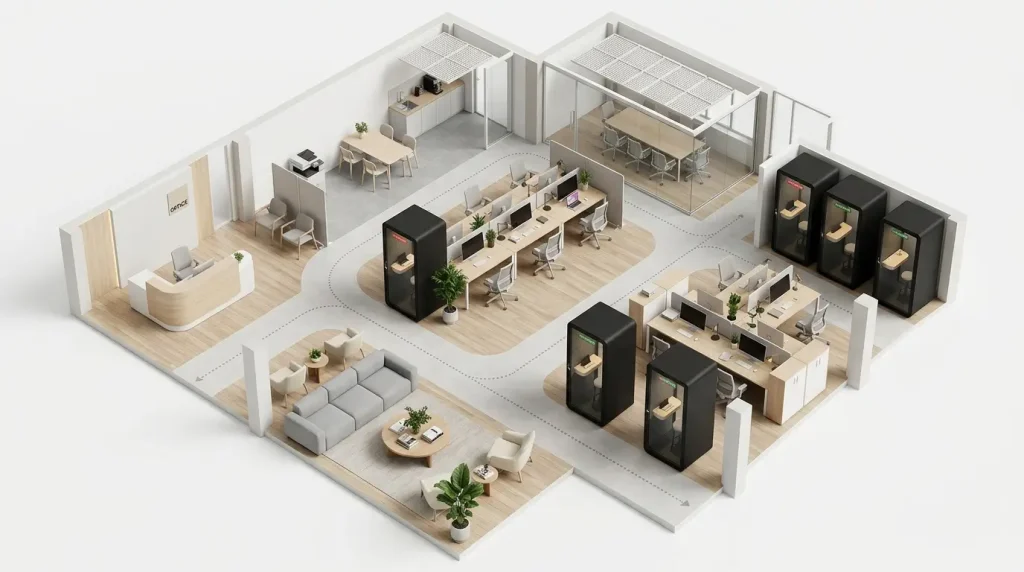
On placement: put booths where people already are. Near desk clusters, next to lounge and breakout zones, just off the reception area. A booth tucked into a dead corner behind the storage room won't get used, and then someone in a budget meeting will ask why you bought it. Visible booths get used.
For UVO's exact dimensions and configurations, see the product page or download the brochure there.
How Much Does an Office Phone Booth Cost?
Prices are all over the map, but for solo booths in 2026 the market roughly breaks into three tiers.
At the bottom, $2,000–$4,000 gets you a budget import. Some are fine. Many cut corners exactly where you can't see it: door seals, glass, ventilation. This is the tier where asking for ISO test data matters most. The middle, $4,000–$7,000, is where solid acoustic performance and decent finishes live. Premium Western brands run $8,000–$15,000 and up — you're paying for smart features, designer finishes, and a good amount of brand.
Meeting pods for four people generally cost two to three times a solo booth.
One thing worth understanding about those retail numbers: they include importer, distributor, and dealer margins stacked on top of the factory price. If you're furnishing a whole floor — or you're a distributor, designer, or contractor buying regularly — going factory-direct changes the math considerably, and it opens up custom sizes and finishes that retail brands simply don't offer.
Buying Direct From a Phone Booth Manufacturer
This is our side of the business, so take it with the obvious grain of salt — but here's what factory-direct actually looks like in practice.
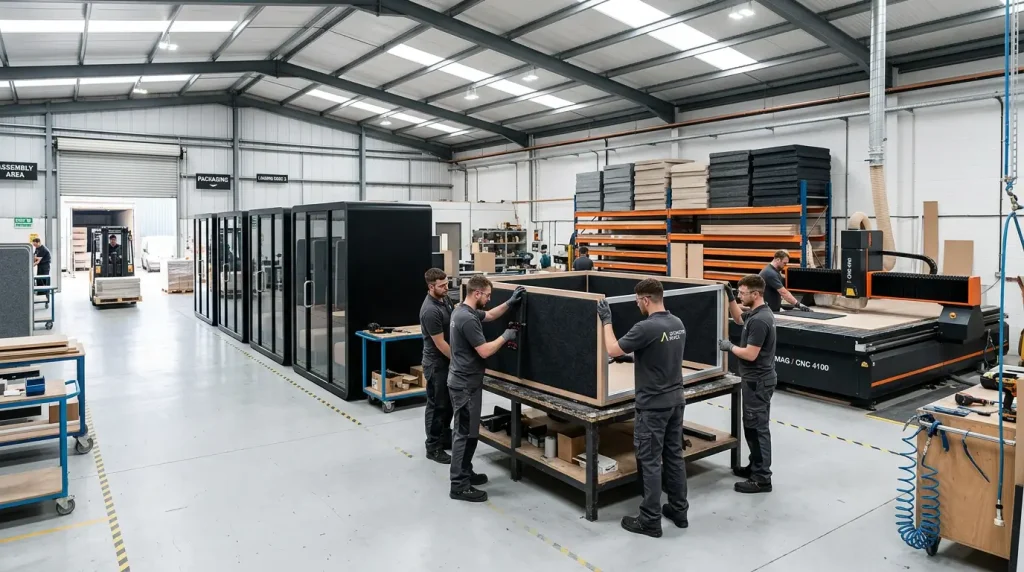
Vision builds acoustic booths and sound-absorbing office furniture at our own factory, supplying distributors, design firms, and corporate projects worldwide. Working with us directly means project pricing that scales with volume (there's a dedicated distributor program for resellers), OEM/ODM customization down to dimensions and logo integration, and a full product range from one supplier — booths, pods, acoustic panels, desks, seating — so finishes actually match across the fit-out instead of “close enough.” Some of our completed installations are in the project cases if you want to see how that looks in real offices.
Comparing suppliers for a project? Send us your requirements and we'll come back with specs, acoustic documentation, and a quote.
Frequently Asked Questions
Are office phone booths really soundproof?
No, and any brand claiming 100% soundproofing is overselling. The honest term is sound-insulated. A quality booth cuts outgoing speech by roughly 25–35 dB, which makes conversation inside unintelligible nearby. Ask for ISO 23351-1 test data rather than trusting the word “soundproof.”
How many phone booths does an office need?
One per 8–12 employees is the usual starting point, plus a meeting pod per 15–20 people. But the reliable method is observation: count simultaneous private calls during your two busiest weeks and buy for that peak.
Do phone booths connect to building ventilation?
No. They have self-contained fans and plug into a normal power outlet. All they need is some clearance above the unit for exhaust.
Can office phone booths be moved?
Yes — that's the whole point of buying furniture instead of building a room. Modular booths break down into panels or roll on casters, and they can move between floors or even between offices.
How long does installation take?
A solo booth, about 1–3 hours with two people. A meeting pod, half a day. No permits, because booths count as furniture rather than construction.
Can I customize size, color, or materials?
Retail brands offer preset finishes and that's it. Manufacturers like us will customize dimensions, exterior finishes, interior fabrics, and branding, particularly on volume and project orders.


