
How High Should Your Desk Be? Why the Standard Desk Height Fails So Many People
- 27 Oct, 2026
- Guides

The standard desk height is 72 to 75 cm (roughly 28 to 30 inches) from floor to top surface, and it is set to suit the middle of the adult population rather than you. Your correct height is the floor-to-elbow measurement taken with your feet flat and your shoulders relaxed, and for anyone unusually short or unusually tall that number lands outside the standard band. What follows is how to get your own figure in about five minutes, how to tell which dimension is actually causing the ache, and how to close the gap without replacing the room.
Key takeaways
- The 72 to 75 cm standard is a manufacturing compromise set near the middle of adult seated elbow height, so being uncomfortable at a standard desk is expected rather than a personal failing.
- Set the chair first: feet flat, thighs roughly level, shoulders relaxed, elbows at about 90 degrees, then measure from the floor to the underside of the elbow. That figure is your target height for the surface your hands work on.
- If the keyboard sits on the desk, subtract its thickness from that measurement, because the keys are what your arms need at elbow height, not the desk top.
- Record three numbers before you shop: target desk height, minimum underside clearance, and minimum depth for your monitor distance.
Standard Desk Height: Where 72 to 75 cm Comes From and Why It Fits Almost Nobody
Walk into any showroom and the desk on the floor will measure somewhere near 73 cm from the floor to the top surface. That figure gets quoted as the standard almost everywhere: 72 to 75 cm, or 28 to 30 inches, or 71 to 76 cm depending on which page you land on, with retail listings spread across roughly 68 to 78 cm as makers add or shave a few centimetres to suit their own tooling.
A fixed-height desk has to be one single number for an entire market. So it gets set near the middle of adult seated elbow height, and near the height that typing desks settled on decades ago, when the working plane was locked in by typewriters and then carried over to keyboards. The result is a compromise between the shortest and tallest buyers a factory expects to serve, and like every compromise it is a poor fit at both ends.
Standards publish bands, not one value
No single height can serve a whole population, so the documents that govern desk dimensions quote ranges, tolerances and adjustment envelopes instead of one mandatory figure. That makes a vague claim of compliance worth very little on its own: ask which document, which edition, and what tolerance applies to the height dimension. If the supplier cannot name the specification behind the claim, what you are reading is marketing rather than compliance.
What that does to you at your desk
The further you sit from the median build, the more the error compounds. A few centimetres of mismatch at the elbow turns into a shoulder that stays slightly shrugged for six hours, into forearms sloping up toward the keys, or into a forward lean that puts the whole upper body weight into the lower back. Chair adjustment recovers part of that gap and only part, which is why so many people adjust everything they can find and still finish the day stiff.
The standard is doing its job. It answers a different question from the one you typed into Google: what height can a factory ship to ten thousand unknown people, rather than what height suits the person sitting here now.
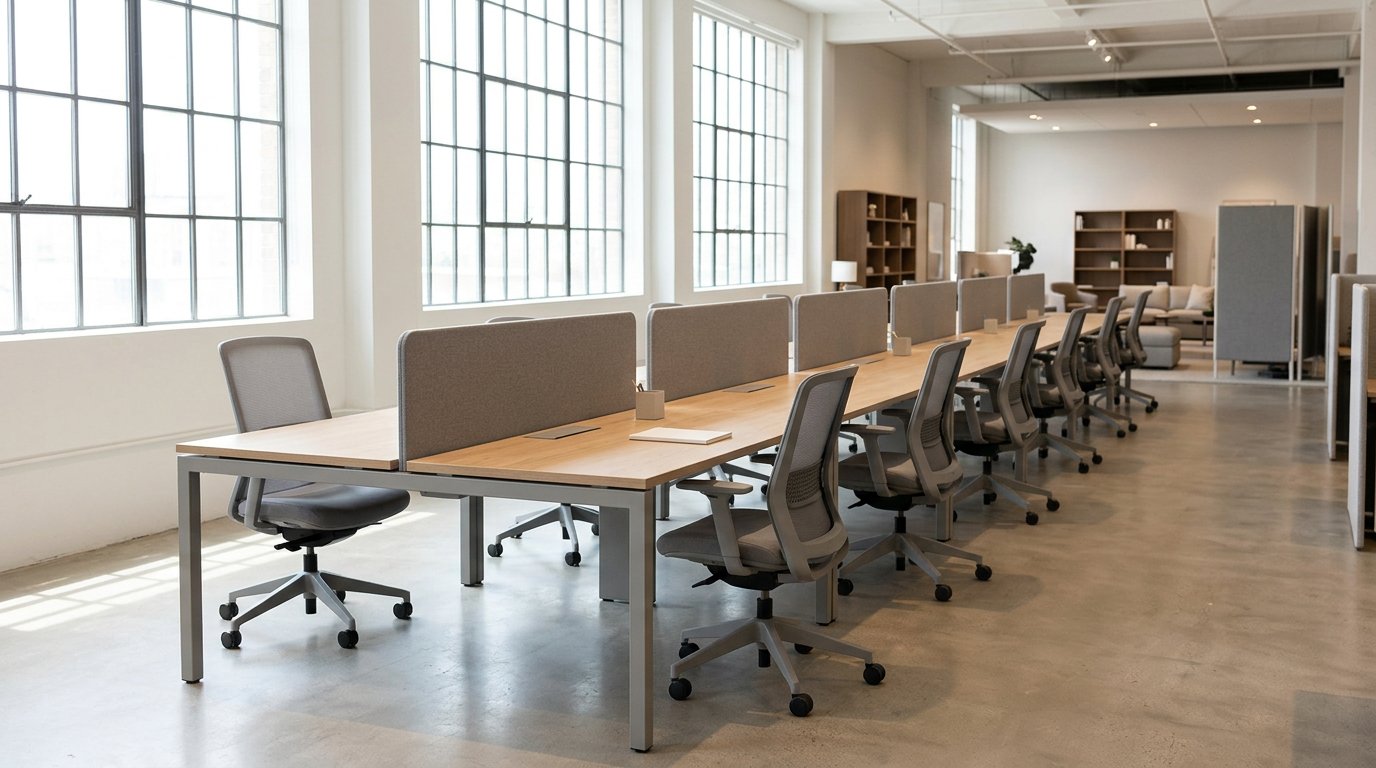
Study tables and writing surfaces mostly come off the same production lines and sit in the same band, so a table bought for a home study inherits the same problem and responds to the same method. For the wider picture on widths, depths and workstation footprints, see common desk sizes and dimensions.
How High Should Your Desk Be Based on Your Height? Set the Chair First
Charts get this wrong because they start from the wrong input. Two people both 175 cm tall can need desks that sit a couple of centimetres apart, because torso length and leg length vary independently. Same stature, different seated elbow height, different correct desk. That is why searching for the standard desk height for 5 4 or the ideal desk height for 6 2 returns a number that only sometimes works: the chart is built from average proportions, and nobody is average in every dimension.
The order of operations matters more than the arithmetic. The chair comes first, because the desk has to meet your elbow, not the floor.
The five-minute measurement
- Sit in the chair you will actually use. Not a kitchen chair standing in for it, and not the chair you plan to buy later.
- Plant both feet flat on the floor. Shoes on if you wear them at the desk.
- Raise or lower the seat until your thighs are roughly level and your knees sit near a right angle. Stop there even if the seat now feels low.
- Let the shoulders drop and hang your arms by your sides. No hunching, no pulling the shoulders back to look tidy.
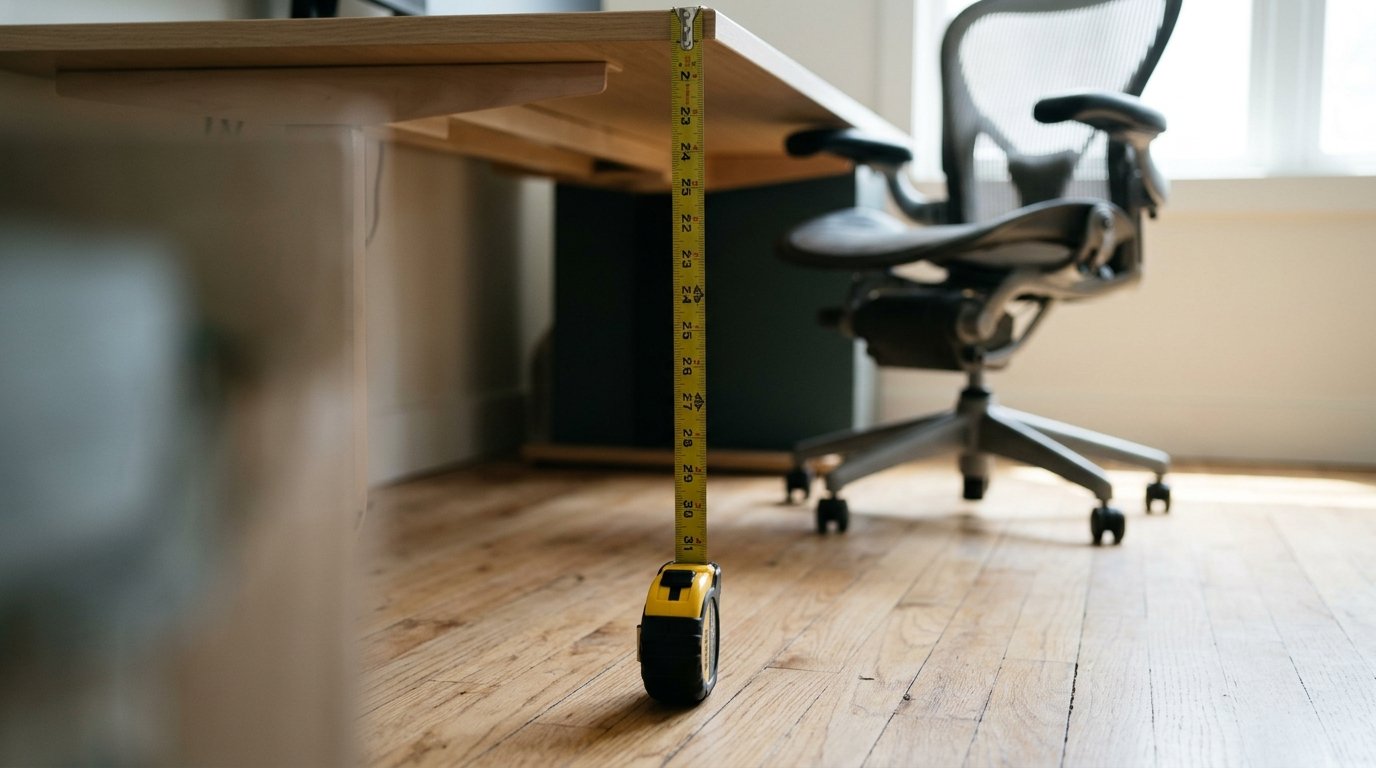
- Bend the elbows to about a right angle and measure from the floor to the underside of the elbow. Keep the forearms horizontal, parallel to the floor.
That measurement is your target height for the surface your hands work on. Write it down before you move.
Then correct for what actually sits on the surface
If your keyboard rests directly on the desk top, subtract the keyboard thickness from the figure you just measured. A chunky mechanical board and a slim low-profile one can differ enough to change the answer. If your wrists rest on a pad, note its height too, because a thick gel pad lifts the hands back up again and undoes the correction.
Sanity check before you trust the number
Set up at that height and type for a minute. Wrists straight, shoulders down, no reaching forward or down. If you have to shrug to reach the keys, the number is wrong whatever the tape measure said, and either the chair moved or something on the surface is taller than you accounted for.
This is also why a chair and a desk have to be chosen and specified together. Swap the chair and the answer changes, so the adjustments on the chair are part of the desk specification rather than an afterthought. Our breakdown of the ergonomic chair adjustments most people never touch covers the levers that matter here.
Four Symptoms That Tell You Which Dimension Is Wrong
Most people diagnose the wrong part of the setup and buy the wrong fix. The table below maps what you feel to what it usually means, so you spend nothing until you know which lever to pull.
| What you feel | What it usually means | What to change first |
|---|---|---|
| Shoulders creep up and the neck stiffens by mid-afternoon | The desk top sits above elbow height, so the forearms slope up toward the keys and the shoulders take the load | Lower the typing surface, raise the seat, or fit a keyboard tray |
| Wrists bent back, tingling or numbness in the hands | The keys sit higher than the desk assumes: a thick keyboard, the rear feet propped up, or a wrist pad under the palms | Flatten the keyboard, fold the rear feet away, or drop the typing surface below the desk top |
| Feet dangling, or the front of the thighs pressing into the seat edge | The chair is too high for the floor. The desk itself may be perfectly fine | Add a footrest, or lower the seat and recheck the elbow height |
| Leaning forward, elbows hanging below the desk, dull ache across the lower back | The desk top sits well above elbow height, so you fold forward to bring your hands down to the keys and the lower back ends up holding the trunk up | Lower the surface if the desk adjusts, or fit a keyboard tray. A footrest alone will not close this gap |
Each symptom has exactly one lever. Raising the monitor to eye level does not fix a keyboard that is too high, and lowering the keyboard does not fix a monitor that is too low. Fixing both at once feels productive and tells you nothing about which change helped.
One opinion, stated plainly: a slightly high desk is the easier error to live with. Raise the chair until your elbows meet the top, put a footrest under your feet to take the support the raise just cost you, and the desk stays structurally sound. A desk that is too low has no cheap rescue. The only way up is a set of properly fixed risers, which changes how the frame carries load and how stable the top feels, or a different desk, and neither is a small job.
The Surface You Measure Is Not Always the Surface You Type On
The desk top is a proxy. What your arms actually need is the typing surface at elbow height, and anything sitting between the two shifts the real figure. This is the detail most height guides skip, and it is the reason plenty of people measure correctly and still hurt.
Keyboard trays: a rescue for one problem, a cost for another
A tray hangs below the desk top and drops the keys to your elbow height without touching the desk itself. For a desk that is slightly too high, that is a legitimate fix, and a cheaper one than a new desk. What you pay for it is knee clearance and usable depth: the tray occupies the front strip of the desk, needs room underneath to travel, and will not fit a desk with a deep drawer box or a full modesty panel. If you are tall and already short of legroom, a tray makes the bigger problem worse.
Laptops force a choice, and the neck loses
A laptop hinges the screen to the keyboard. Raise the screen to eye level and the keyboard climbs with it. Drop the keyboard to elbow height and the neck folds down to meet the screen. There is no single-position answer, which is why the workable laptop setup is a stand plus a separate keyboard and mouse, with the laptop screen doing duty as a second display at eye level.
Monitor placement sets the depth you need
The top of the screen should sit roughly at or just below eye level, about an arm’s length from your face. That distance is the number that decides desk depth, and it is why a shallow desk pushes people into leaning forward to read. Deep enough to hold a monitor at arm’s length with a keyboard in front, shallow enough that nothing sits beyond comfortable reach. Monitor arms earn their place here because they reclaim the depth the factory stand was using, and our notes on the accessories that actually earn their keep go further into that trade-off.
Writing and drafting surfaces are a different number
Drafting tables sit higher than typing desks because the work happens at a steeper angle, with the forearm supported by the board rather than hovering over keys. A drafter, a note-taking writer and a programmer should not be aiming at the same figure. If your day is split between them, pick the surface for the work you do most and treat the rest as occasional.
If You Are Shorter Than the Standard Desk: Chair Up, Footrest Down
The fix for most people the standard fails costs a fraction of a new desk, and it comes in two parts that only work together.
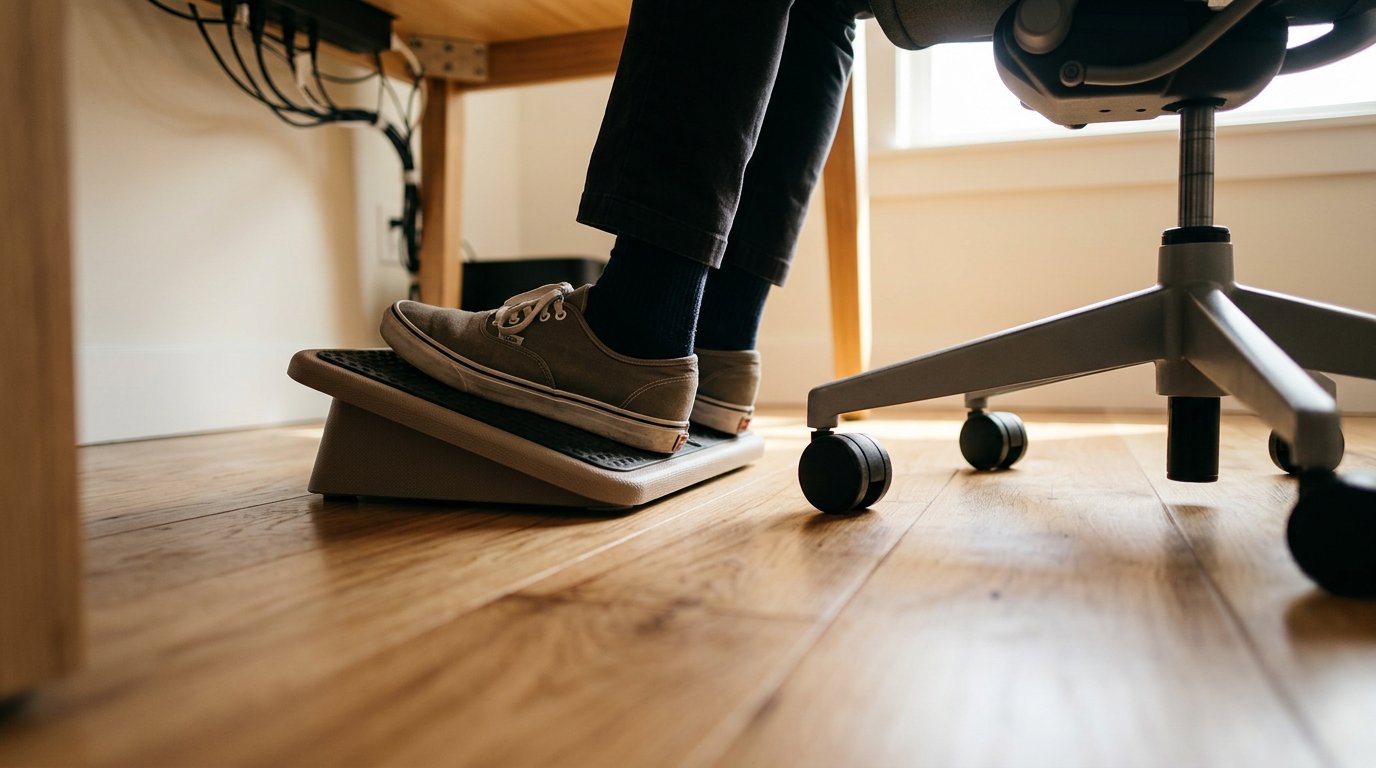
- The mechanism. Raise the chair until your elbows meet the desk top. That lifts your feet off the floor, so a footrest has to restore the support you just lost. Chair up without a footrest simply trades a shoulder problem for a numb, dangling leg.
- What a footrest has to do. Fill the exact gap between your soles and the floor, not approximately fill it. Let the ankle angle change through the day, because a fixed flat plate forces one position for eight hours. Stay where you put it instead of skating away mid-task, which rules out anything light and smooth on a hard floor.
- Do not cut the legs down. Shortening a desk changes its structure, almost always voids the warranty, and usually leaves a top that rocks because the four legs no longer agree. Shimming the frame has the same failure mode in reverse.
- When a keyboard tray beats a footrest. A tray lowers only the typing surface, so you keep your legroom and can leave the seat where it is. That is often the better lever for someone whose chair is already at the bottom of its adjustment range.
- The point where the desk has to change. Once raising the chair pushes your knees above the seat or lifts your thighs off the cushion, the desk is too far from your build. The chair cannot fix that, and forcing it will cost you circulation and stability.
Once the chair and footrest are in place, run the whole check in one pass. Sit back, let the shoulders drop, and look at three things: forearms roughly level with the desk top, thighs roughly level with the floor, feet planted flat rather than searching for the plate. Whatever is still off is the lever you have not moved yet. If the room layout is still open, our guide to furnishing a home office that does not wreck your back covers the decisions that sit above the height question.
If You Are Taller Than the Standard Desk: Risers, and Whether 85 cm Is Too High
The opposite failure looks different and feels just as bad. Knees jam against the underside of the desk, the keyboard sits so low that you slump forward to reach it, and the lower back takes the load all day. Tall users tend to under-report this because they have spent years assuming desks are simply like that.
Risers and blocks have to be engineering, not improvisation
A desk raised on blocks is workable if and only if the blocks are sized to fit the feet, fixed in place, and rated for the load. A desk that shifts or topples when someone leans a forearm on it is a genuine hazard, and a stack of books or a couple of bricks is not a fix. A raised desk also needs a taller chair with a deeper seat and, usually, a footrest, otherwise you simply move the problem from your knees to your feet.
Is 85 cm too high for a desk?
For most seated office work, yes. Eighty-five centimetres is roughly 10 cm above the top of the standard band, which puts the keys well above elbow height for an average build. It can be close to right for a very tall user whose chair is set correctly, and it is a normal height for a standing or counter-height surface used with a stool. Note that 85 cm is also where plenty of people land after stacking risers under a standard desk, which is worth remembering when the fix starts to feel permanent.
The height almost everyone forgets: underside clearance
Top surface and underside clearance are two different numbers and both matter. A desk can sit at exactly the right height to type at and still be unusable because the frame rail, modesty panel or drawer box blocks your knees. Ask for both figures in writing, in centimetres, measured from the floor.
Here is the test that settles it in ten seconds. Sit down at the desk, cross one leg over the other, and check whether the thigh clears the underside without your shoulders rising to make room. If you have to shrug or shuffle forward to fit your legs under, the clearance is wrong no matter what the top height says.
What to Ask For When Adjusting Is Not Enough
Once you know your numbers, the buying conversation gets short and specific. Three figures do most of the work.
- Write down three numbers. Your target top-of-desk height from the elbow measurement, your minimum underside clearance for the thighs, and your minimum depth for the monitor distance you settled on. Carry them into every showroom and every quotation.
- Fixed desks suit one person with one posture. That is fine for a single assigned workstation and a settled team. It stops being fine the moment a desk is shared, the team is still growing, or the same person wants to change posture during the day.
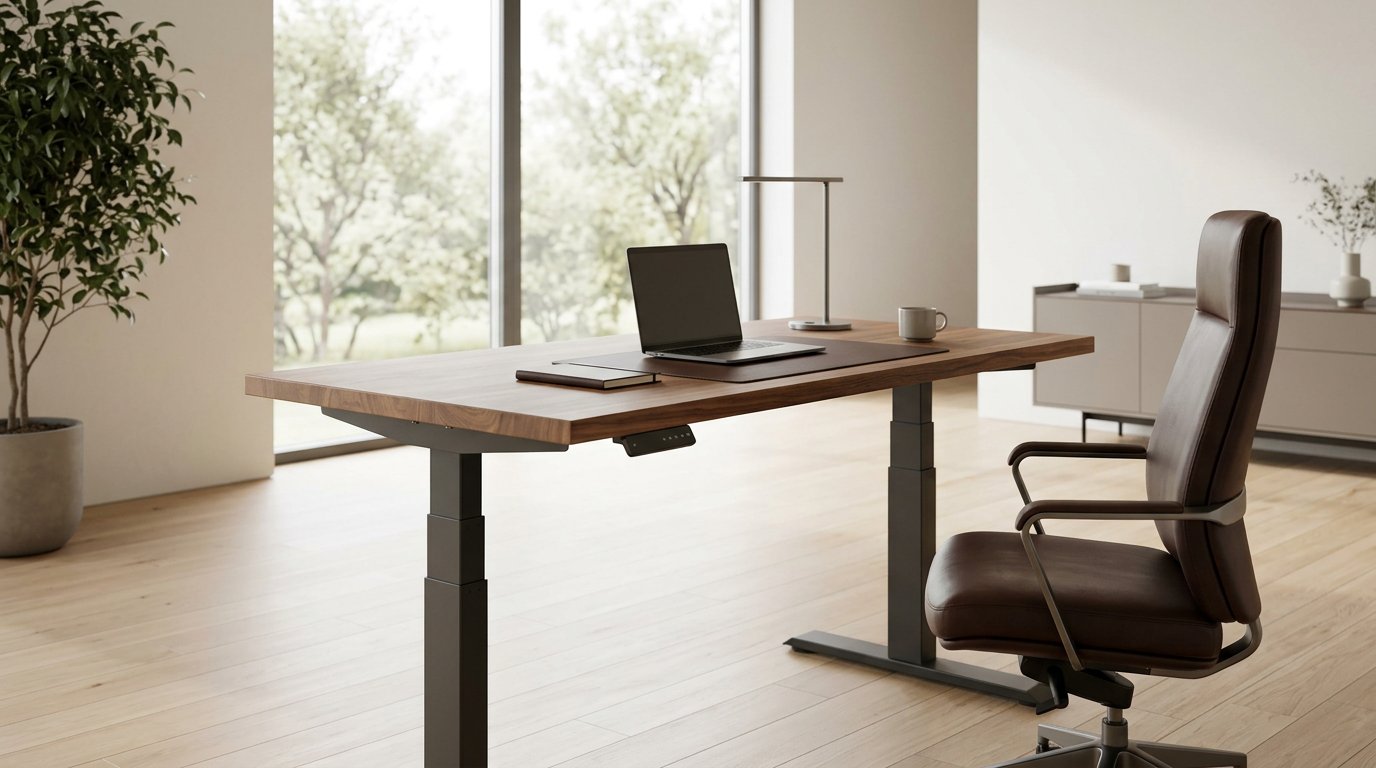
- A lift-type desk covers a range instead of a point. Vision builds lift-type desks under the names IN EXECUTIVE, ULIX EXECUTIVE and OBOL EXECUTIVE, alongside a wider catalogue of office chairs, desks and workstations, sofas, filing cabinets and meeting tables. Ask for the actual travel range and the underside clearance at both ends of it before ordering, and do not assume a lift desk automatically suits a short or very tall user. Our comparison of height-adjustable desks and standing desk converters is worth reading before you choose the format.
- Fitting out a whole floor changes the problem. One standard height across a diverse team guarantees a complaint queue. Specify a mix, or specify a range, and treat the chairs as part of the same specification rather than a separate purchase order.
- If your number falls outside everything in a catalogue, say so. OEM and ODM production is a real option in this category and worth raising with a supplier before you accept a compromise on height.
Bring the three numbers to Vision and the team can match them against the range rather than guessing at it. As a manufacturer with facilities in Foshan and Guangzhou and more than 30 years in this industry, Vision ships OEM and ODM work worldwide, and every order includes a warranty and spare-part support, with documentation such as CO, BL and export licence handled by the logistics team.
Frequently asked questions
What is the standard height of a chair in feet?
Most task chair seats adjust somewhere between about 40 and 50 cm, which is roughly 1.3 to 1.6 feet, though the range varies by model. The seat height that matters is the one that puts your thighs level with your feet flat and your elbows at desk height, so check the adjustment range on the spec sheet rather than the number on the label.
What is the standard height of a study table in centimeters?
Study tables usually ship in the same 72 to 75 cm band as office desks, because they come off the same production lines. Shorter users therefore hit the same problem and need the same fix: raise the chair until the elbows meet the top, add a footrest to restore foot support, or fit a keyboard tray if legroom allows.
What is a standard desk depth?
Depth is far less standardised than height, with work desks commonly spanning roughly 60 cm for compact workstations up to 80 cm or more for executive tops. Choose it from your monitor distance: about an arm’s length from your eyes to the screen, plus enough room in front for the keyboard without pushing you into a forward lean.


