
The Science of Sitting: How Posture, Pressure Points, and Chair Design Actually Interact
- 28 Jul, 2026
- Guides
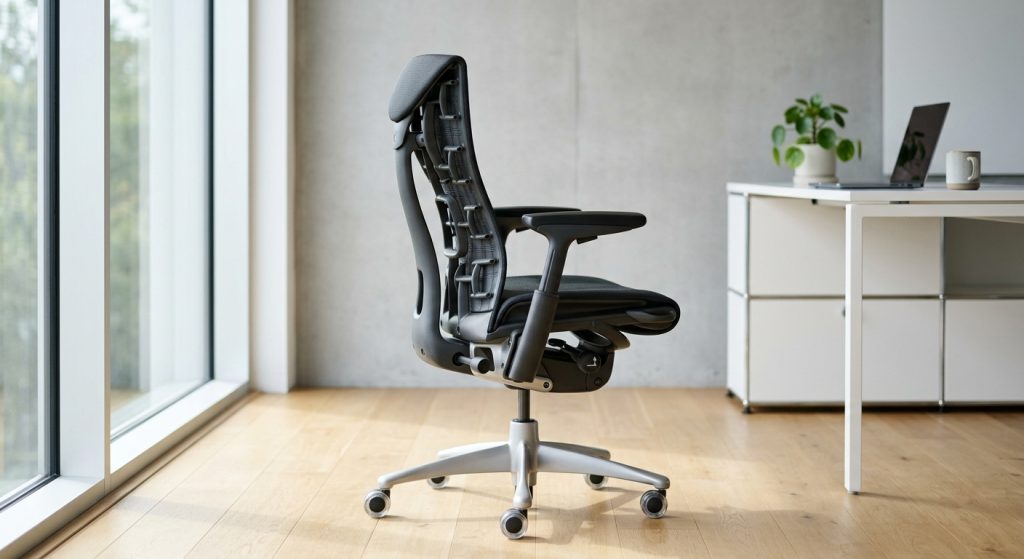
Sitting comfortably isn’t about softness — it’s about how a chair distributes your body weight across pressure points and holds your spine’s three natural curves without forcing your muscles to work overtime just to stay upright. A chair that ignores this physics will always feel wrong eventually, no matter how plush the foam is. Get the mechanics right, and even a modest chair can outperform an expensive one that ignores anatomy.
Your Sit Bones Are Carrying More Weight Than You Think
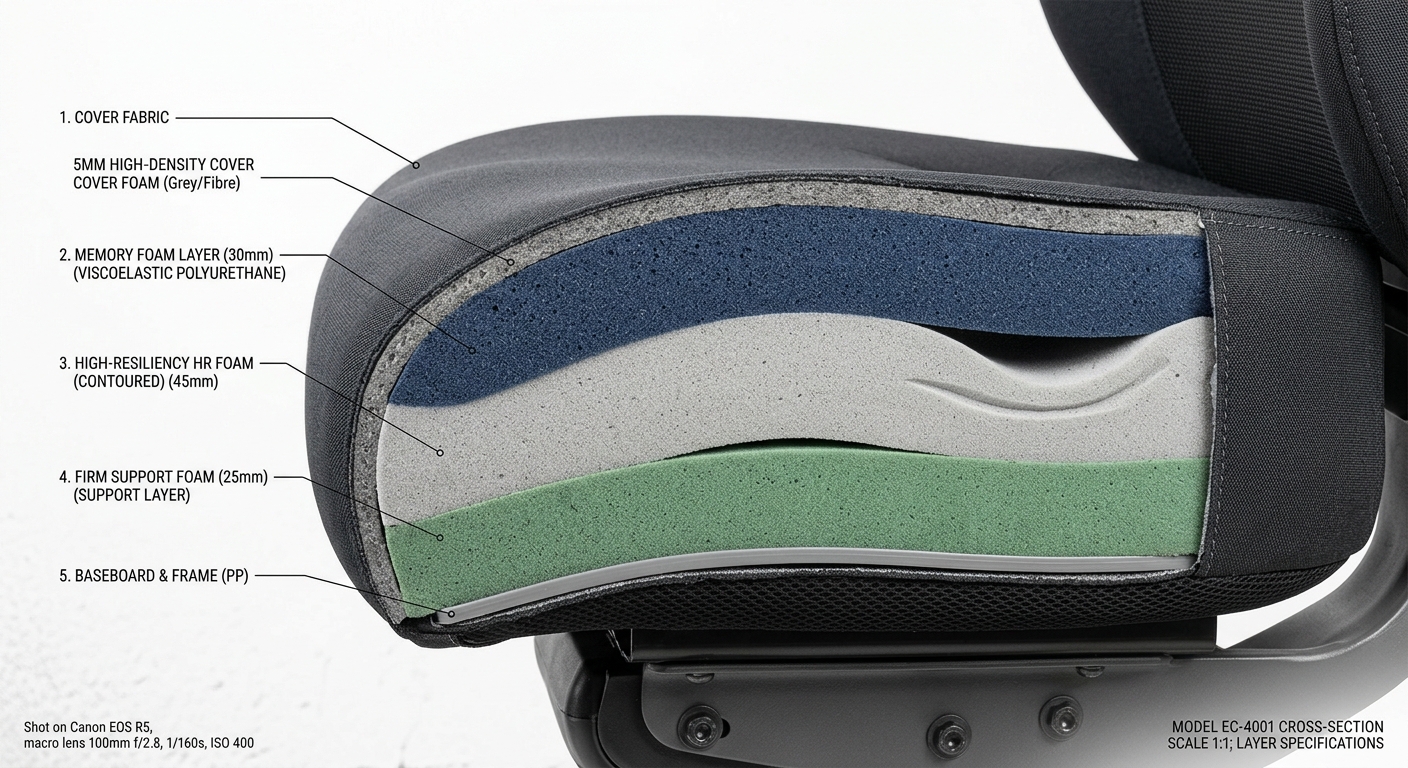
Here’s a number that surprises most people: when you sit down, roughly 75% of your upper body weight funnels through two bony points at the base of your pelvis called the ischial tuberosities. That’s it. Two small areas, maybe the size of a couple of quarters each, absorbing the load that your legs and feet used to share while standing.
When a seat cushion is too soft, those bones sink in and create localized pressure spikes — think of pressing your thumb into a pillow versus a firm mattress. Too firm, and the same thing happens but faster, because there’s no material to spread the load outward. The sweet spot is a cushion dense enough to resist bottoming out but contoured enough to redistribute weight across the surrounding gluteal tissue, not just the two pressure points.
This is exactly why mesh, foam, and hybrid seat cushions perform so differently in real-world testing — the material science directly determines how pressure gets mapped across your seat, not just how it feels on first sit.
The Spine Wants an S-Curve, Not a C-Curve
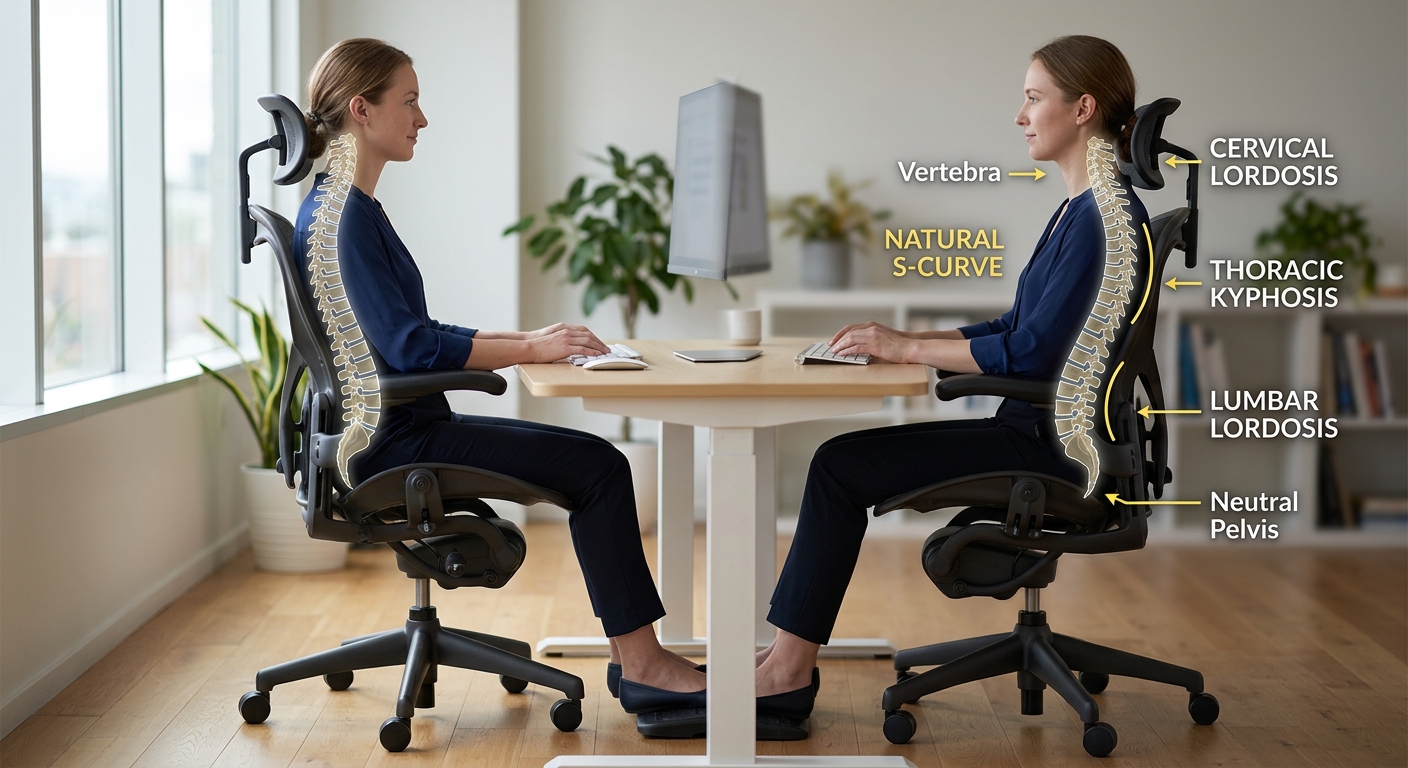
A healthy spine has three curves — cervical (neck), thoracic (upper back), and lumbar (lower back) — that together form a gentle S-shape. Slouching collapses that into a C-shape, flattening the lumbar curve and putting the anterior discs of your lower vertebrae under uneven compression. Do that for six hours a day, five days a week, and you’re looking at chronic lower back strain that no amount of stretching will fully undo.
Why lumbar support only works if it’s positioned correctly
A lumbar bump sitting two inches too low or too high does almost nothing — it just becomes a pressure point in the wrong place. Effective lumbar support sits right at the inward curve of your lower back, typically 6-10 inches above the seat pan depending on torso length, and it should be height-adjustable rather than fixed. This is one of the most commonly skipped adjustments; we covered exactly which controls get ignored in ergonomic chair adjustments most people never touch.
Recline Isn’t Laziness — It’s Load Redistribution
Leaning back 10-15 degrees from vertical actually reduces spinal disc pressure by shifting some load from your lumbar spine to the backrest. Studies on seated disc pressure (going back to Åke Nachemson’s classic work in the 1960s, still cited today) show upright 90-degree sitting creates more intradiscal pressure than a moderate recline. So that instinct to lean back after lunch isn’t slacking — it’s your body self-correcting for load.
The catch is that recline only helps if the backrest has synchronized tilt tension matched to your body weight. A backrest that’s too stiff won’t move enough to relieve pressure; one that’s too loose lets you flop backward and lose lumbar contact entirely. Quality task chairs let you dial in tension so the recline resistance actually matches your mass — a detail manufacturer spec sheets rarely explain well, which is part of why we wrote about why manufacturer weight ratings mislead you.
Seat Depth: The Adjustment Nobody Talks About
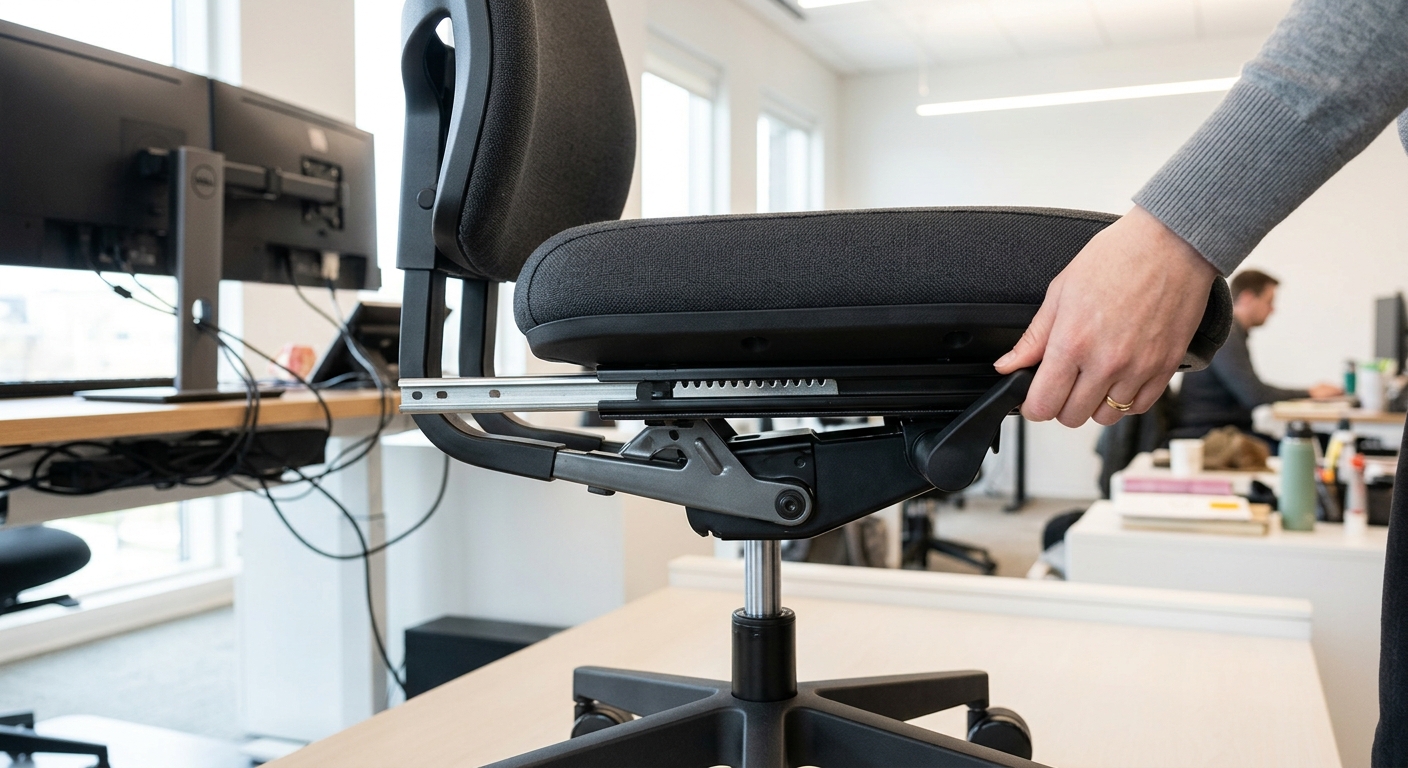
Seat depth gets ignored constantly, yet it’s directly responsible for one of the most common complaints — numb legs or tingling behind the knees. If the seat pan is too long for your thighs, the front edge presses into the popliteal fossa (the soft tissue behind your knee packed with blood vessels and nerves), restricting circulation exactly the way a tight sock does, just with more weight behind it.
The fix is a seat pan that slides — typically offering 2 to 4 inches of adjustment — so there’s a two-to-three finger gap between the seat edge and the back of your knee when your feet are flat on the floor. Shorter users in particular get shortchanged by fixed-depth seats designed around average torso-to-leg ratios.
A real-world example
A coworking operator we worked with had persistent complaints from members under 5’4” about leg numbness — despite using chairs rated highly for ergonomics. The issue wasn’t the cushion or lumbar support at all; it was fixed seat depth. Switching to chairs with adjustable seat sliders resolved the complaints almost entirely within a week, without changing anything else in the space. That’s the kind of practical lesson we dig into in furnishing a coworking space for durability and retention.
Armrests Change Your Shoulder Mechanics More Than You’d Guess
Poorly positioned armrests are a sneaky cause of neck and shoulder tension. If armrests sit too high relative to your desk, your shoulders stay elevated in a low-grade shrug for hours — a posture that fatigues the trapezius muscles and contributes to tension headaches. Too low, and your shoulders drop and rotate inward, rounding the upper back forward.
The ideal setup: elbows bent at roughly 90-100 degrees, forearms resting lightly (not pressing down) on the armrest, with the armrest height matched to your desk surface so your wrists stay level while typing. This is why 4D-adjustable armrests — height, width, depth, and pivot — outperform fixed ones for anyone working 6+ hours a day, a point we expand on in our buyer’s guide to office chairs for 8+ hour workdays.
Why Two People in the Same Chair Report Different Comfort
This is the part chair marketing conveniently skips: pressure mapping studies consistently show that identical chairs produce different pressure distributions across different body types, because bone structure, tissue density, and weight distribution vary person to person. A 130 lb employee and a 220 lb employee sitting in the same unmounted-tension chair are experiencing completely different biomechanical loads.
This is exactly why static “one-size-fits-all” chairs fail so often in mixed-workforce environments like open offices or call centers, where dozens of different body types cycle through the same seating. If you’re furnishing a space with high seat turnover, it’s worth reading how we approached this in furnishing a call center with chairs built for 24/7 use — the answer isn’t more cushioning, it’s more adjustability range.

The Two-Week Adjustment Curve Is Real Biomechanics, Not Placebo
Ever notice a new chair feels great on day one and oddly uncomfortable by week two? That’s not a defective product — it’s your muscles and tendons adapting to a new resting posture, and in the process, revealing compensation patterns your old chair was masking. Postural muscles take 10-14 days to recalibrate to a new baseline, which is exactly the window where most of the “this chair is bad” complaints show up.
We covered the mechanics of this adjustment period in detail in why new office furniture feels uncomfortable after two weeks — the short version is that discomfort in that window is usually diagnostic, not damning. If it persists past three weeks, though, that’s when it points to an actual sizing or adjustment mismatch worth fixing.


