
Modular Workstations vs. Fixed Cubicles: Which Scales Better With Your Headcount in 2026?
- 18 Jun, 2026
- Guides
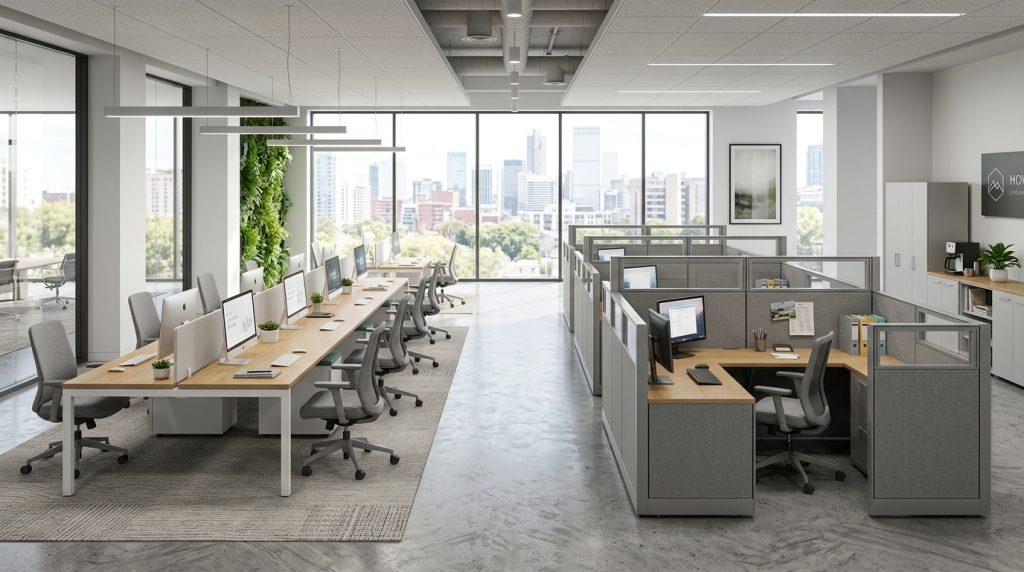
Modular workstations scale better than fixed cubicles for nearly every growing or hybrid team in 2026 — they reconfigure in hours, reuse components across moves, and lower five-year cost per seat by roughly 20–35%. Fixed cubicles still win in two narrow scenarios: stable headcount with heavy phone privacy needs, and budget-constrained one-time fitouts where you will not touch the layout for at least seven years. Everything else points toward modular.
The Real Question Isn’t Modular vs. Cubicle — It’s Your Growth Curve
Most procurement managers ask the wrong question. They compare price tags side by side, see cubicles come in 25% cheaper per seat, and call it a day. Then 18 months later they are paying contractors $400 a station to dismantle panels they cannot reuse.
The right question is: how much will your headcount and floor plan change over the next five years? If the answer is “more than 10% per year” or “we’re not sure,” modular wins before you even open the catalog. Fixed cubicles assume the future looks like the present. In 2026, that is a bold assumption.
A useful exercise: pull your last three years of hiring data and your last two lease renewals. If either line is jagged, you need furniture that bends with it.
What Each System Actually Is (Beyond the Marketing)
Terminology has drifted, so let’s pin it down.
Fixed cubicles
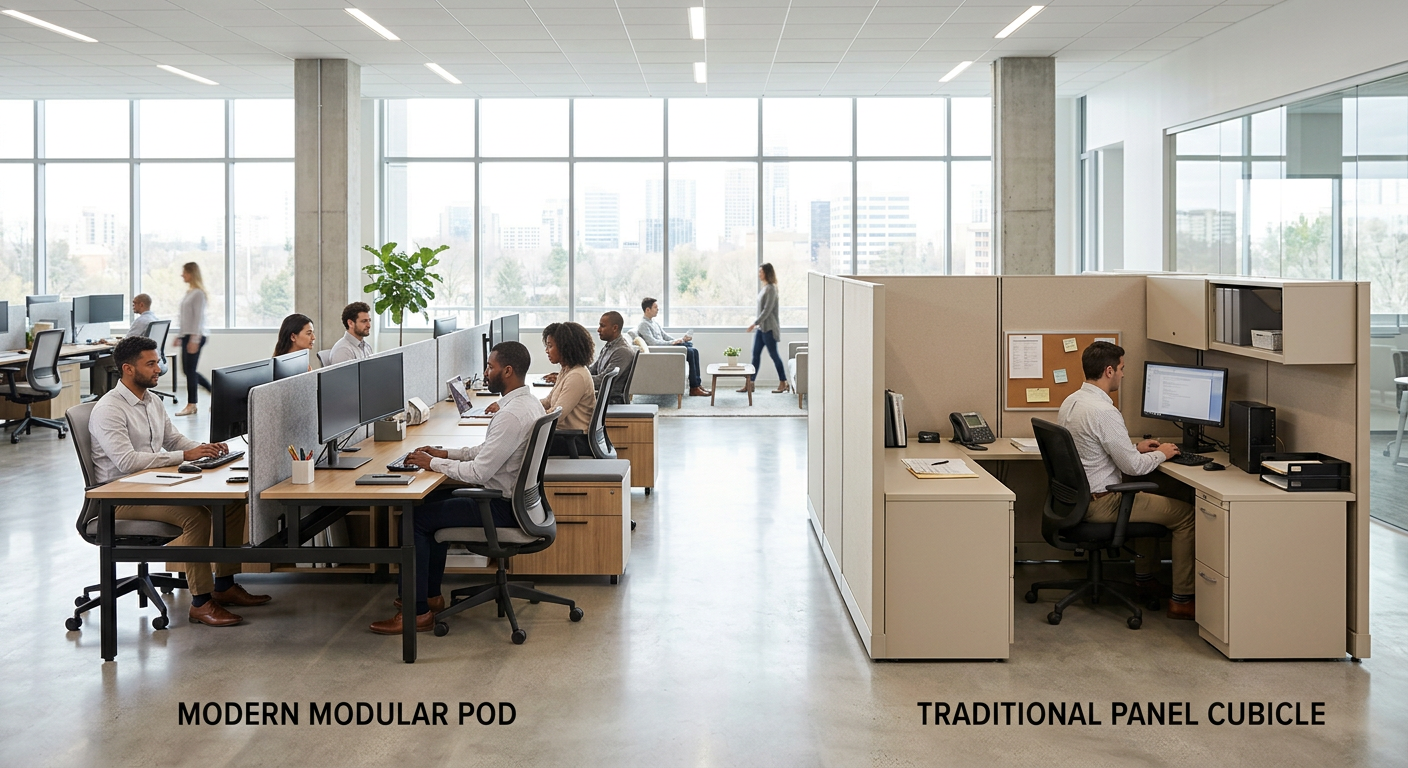
Panel-based systems with permanently mounted work surfaces, overhead bins, and integrated electrical chases inside the panels themselves. Panels typically run 53–67 inches tall. Once installed, moving a single station requires disconnecting power, removing connectors, and often patching carpet. Think of the classic 6×6 or 8×8 cube farm.
Modular workstations
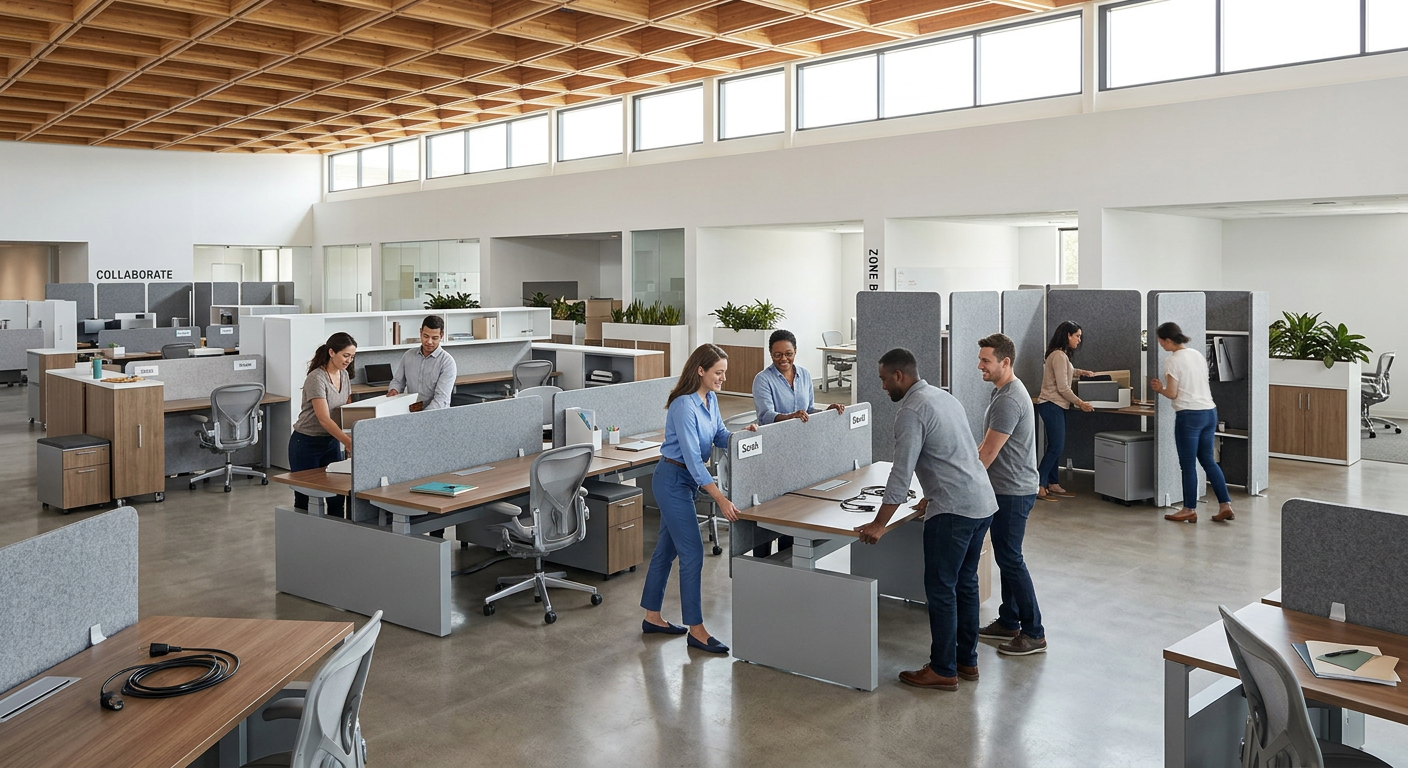
Bench-style or pod-style desks where the work surface, screens, storage, and power are independent, swappable components. Privacy screens clip on. Power runs through under-desk trays or floor grommets, not through the panels. A team of two can reconfigure a 12-person pod in a Saturday afternoon.
The line blurs in the middle — some vendors sell “modular cubicles” that are really just lighter-weight panel systems. Ask one question to cut through the fog: can your in-house facilities team reconfigure a station without a certified installer? If yes, it is genuinely modular.
Head-to-Head: The Numbers That Matter
Here is the comparison most buyers actually need, with realistic 2026 pricing from mid-tier commercial vendors:
| Criteria | Modular Workstations | Fixed Cubicles |
|---|---|---|
| Reconfiguration time | Hours, in-house | Days, contractor |
| Cost per seat (initial) | $1,200–$2,800 | $900–$1,800 |
| 5-year total cost of ownership | Lower (reusable parts) | Higher (replace on remodel) |
| Lead time | 4–8 weeks | 6–12 weeks |
| Best for headcount change | ±30% annually | Stable ±5% |
| Privacy level | Moderate, adjustable | High, fixed |
| Cable management | Integrated raceways | Built-in panel chases |
| Resale / reuse value | High | Low |
Notice the trap: cubicles look 30% cheaper on day one, but they lose roughly 70% of their value the moment you remove them from the wall they were specified against. Modular components hold value because they ship flat, store flat, and reinstall flat.
Scalability Scenarios: Where Each System Breaks
Scenario 1: The 40-person SaaS company expecting to hit 90 by Q4
Modular, no contest. The team can add 50 seats by ordering more desks, screens, and power modules that bolt onto the existing benches. No demo. No re-permitting. A facilities lead I spoke with at a Series B fintech reconfigured 22 stations into 31 over a single weekend using their existing bench frames — total spend was under $14,000 for the eight new seats.
Scenario 2: The 200-person insurance claims office
Fixed cubicles still make sense. The team is unionized, headcount has moved less than 3% in five years, and agents need 65-inch panels for phone privacy and screen confidentiality. Reconfigurability is a non-feature here — they actively don’t want anyone moving things.
Scenario 3: The hybrid 80-person agency with 45% in-office on peak days
This is where modular dominates and cubicles fail outright. You need hot desks, drop-in benches, and the ability to convert a quiet zone into a project room overnight. Read our take on furnishing hybrid workplaces for the deeper playbook — but spoiler: fixed panels lose every time in a hybrid floor plan.
The Hidden Cost Categories Nobody Quotes
Vendor quotes only cover what is in the box. Here is what bites you later:
- Reconfiguration labor. Cubicle teardown averages $180–$350 per station with a union crew. Modular benches: $0, your team handles it.
- Electrical re-permitting. Many jurisdictions require a new permit when you move hardwired panel power. Modular systems use plug-and-play whips that typically don’t trigger a permit.
- Carpet damage. Cubicle panel feet leave deep dents and screw holes. Budget $8–$14 per square foot for replacement on a remodel.
- Storage between moves. Disassembled cubicle panels are awkward, oversized, and easily damaged. Modular components stack on standard pallets.
- Resale. Used cubicles fetch 10–15% of original price. Used modular bench frames in good condition fetch 35–50%.
Roll those into a five-year model and the “cheaper” cubicle frequently costs 25–40% more per seat-year than the modular alternative.
Privacy Is the One Place Cubicles Still Win
Let’s not pretend modular furniture solves every problem. If your team handles HIPAA-protected calls, sensitive legal review, or sustained concentration work, a 67-inch panel surrounding three sides of a desk does something a clip-on screen cannot: it blocks visual distraction across the entire seated and standing field of view, and it absorbs roughly 0.65–0.80 NRC of voice frequencies depending on fabric.
Modular systems counter with taller add-on screens (up to 54 inches), acoustic baffles, and pod-style booths — but you are reassembling cubicle-like privacy out of parts. If 80% of your team needs that privacy 80% of the time, just buy well-designed cubicles and stop fighting physics. For everyone else, modular plus a few enclosed focus rooms is the smarter play.
Lead Time and Supply Chain Reality in 2026
Component availability has shifted since 2023. Modular bench systems now lead the market on lead times because their parts are higher-volume SKUs — a 60-inch worksurface is a 60-inch worksurface across thousands of installations. Custom panel cubicles, especially anything with non-standard heights or fabric, are running 8–12 weeks from order to install in most North American markets.
If you have a lease starting in 90 days, modular is the only realistic path unless you commit by week one. We have seen project managers lose move-in dates because they fell in love with a custom cubicle finish that needed 14 weeks of fabric lead time. Don’t be that project manager. If you need help mapping a delivery timeline against your move-in, our office furniture solutions team can model it backward from your lease date.
How to Decide in 15 Minutes
Skip the spreadsheet. Answer these five questions honestly:
- Will your headcount change by more than 10% in any of the next three years? Yes → modular.
- Do more than half your staff handle confidential audio or visual work full-time? Yes → cubicles.
- Will you still occupy this exact floor plan in five years? No or unsure → modular.
- Does your facilities team have the bandwidth to manage reconfigurations? Yes → modular pays off. No → cubicles or full-service modular contract.
- Is the lease longer than seven years and stable? Yes → cubicles become competitive. No → modular.
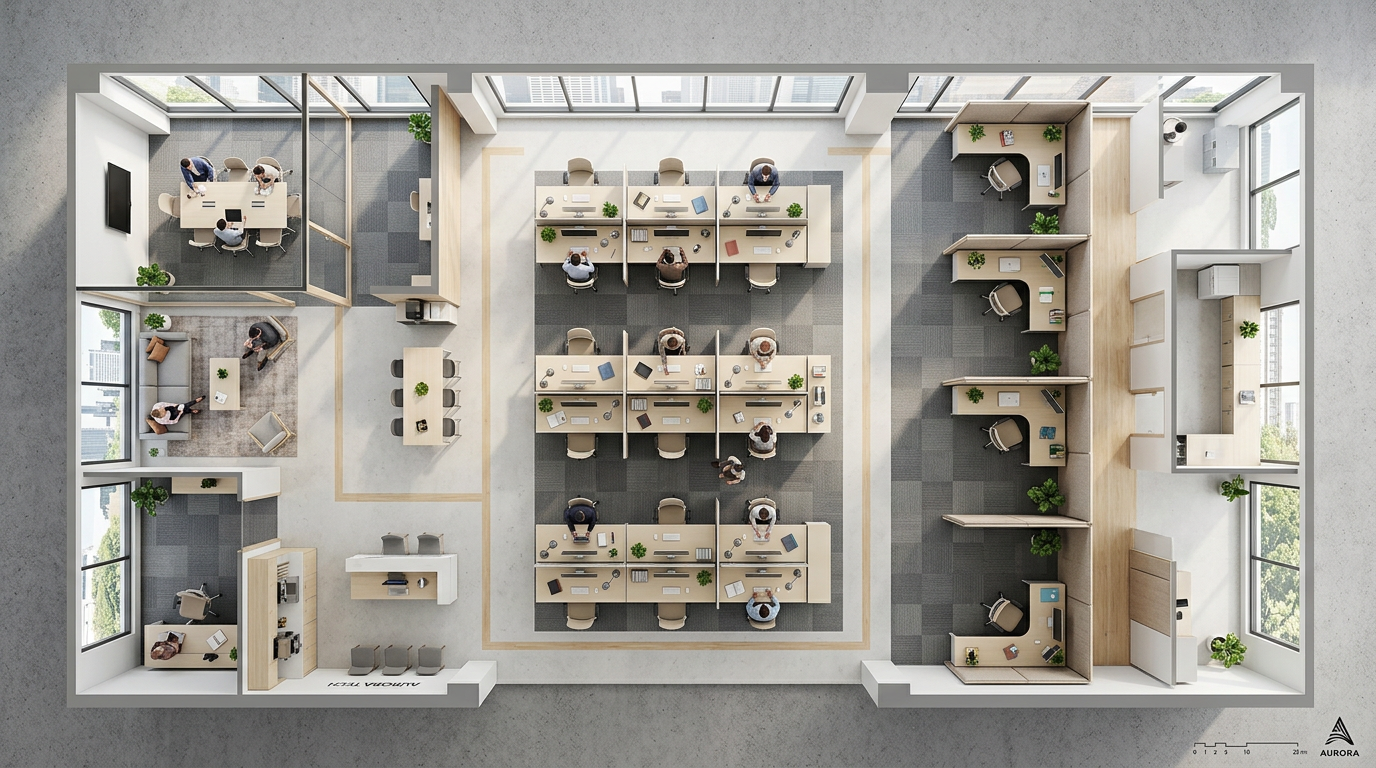
Three or more “modular” answers and the decision is made. If you scored two-two-one, hybrid the floor — modular benches in collaboration zones, a small bank of cubicles for privacy-heavy roles. For broader layout strategy, the open plan vs. private office breakdown pairs well with this decision.
Specifying the Right Modular System If You Go That Route
Not all modular is created equal. When you spec, demand these five things in writing:
- Bench frame load rating: minimum 200 lbs per linear foot static, 400 lbs point load. Cheap bench frames sag at the joint after 18 months.
- Power module modularity: daisy-chainable, replaceable without removing the worksurface. Look for UL 962A compliance.
- Screen mounting standard: universal clamp profile (not proprietary). You want to swap a 14-inch screen for a 30-inch one without buying a new desk.
- Cable tray capacity: minimum 4-inch depth, with separate compartments for power and data.
- Replacement part guarantee: 10 years on frames, 5 on power. Without this, “modular” becomes “disposable” the day the vendor refreshes their product line.
If you also need to size the desks themselves, our desk dimensions guide covers the actual measurements that work for different task profiles, and the case for sit-stand integration is worth reviewing before you finalize.
Putting It Into Practice
For most companies hiring, restructuring, or operating hybrid in 2026, modular workstations are the better scaling bet — lower five-year cost, faster reconfiguration, better resale. Fixed cubicles are not dead; they are the right tool for stable, privacy-intensive operations that won’t change shape for the better part of a decade. The mistake is choosing based on day-one sticker price instead of the five-year curve.
If you want a second set of eyes on your specific floor plan, headcount projection, or RFP, the team at vision-furniture builds both modular and panel systems and will tell you straight which one fits — even when the answer is the cheaper one. Browse our recent project case studies to see how other teams sized their decision, or start a conversation through our service page when you are ready to spec.


