
Sustainable Office Furniture: A Practical Guide to Circular Sourcing and End-of-Life Materials
- 24 Sep, 2026
- Buyer Education
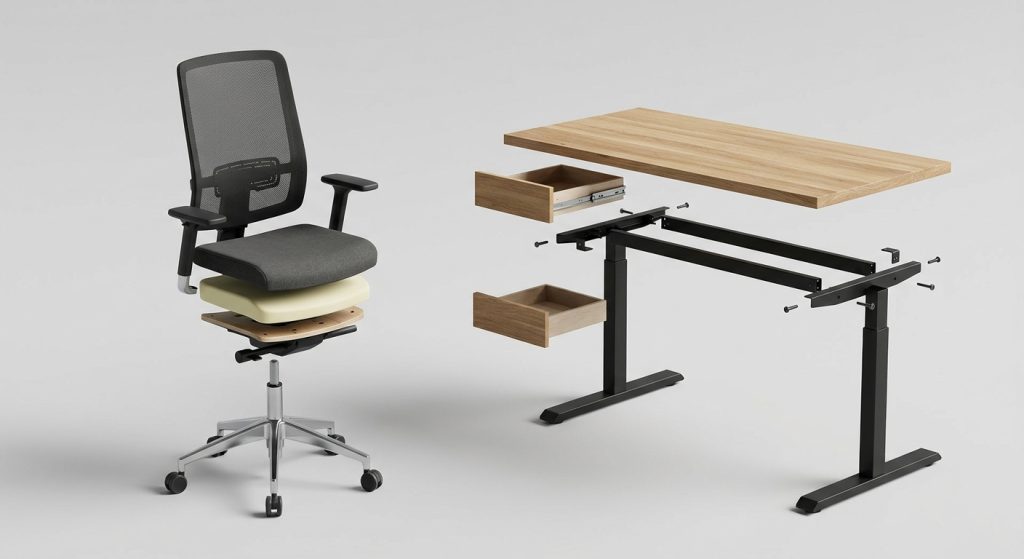
Sustainable office furniture means buying pieces designed for disassembly, material recovery, and a second life — not just furniture made from recycled content once. The real test isn’t what a chair is made of on day one; it’s whether the steel, foam, and fabric can be separated and reused when the chair dies ten years from now. Most ‘eco-friendly’ furniture marketing skips that second half entirely, and that’s exactly where buyers get misled.
Why ‘Recycled Materials’ Is the Wrong Question to Ask First
Here’s an uncomfortable truth: a chair can be made from 80% recycled ocean plastic and still be a landfill-bound disaster. Why? Because if the manufacturer bonded that recycled plastic to a steel frame with industrial adhesive, foam, and mixed-fiber fabric, nobody can pull those materials apart again. You’ve just delayed the waste problem by one product cycle.
The smarter question is: can this piece be disassembled into single-material streams at end of life? That’s the entire premise of circular design. A steel-frame task chair with mechanically fastened (not glued) components, a mono-material mesh back, and a replaceable foam seat pan can theoretically feed three separate recycling streams. A molded plastic-and-foam chair fused into one unit generally can’t feed any.
What to actually check
- Are components screwed/clipped together, or bonded with adhesive?
- Can the upholstery be removed without cutting or tearing the frame?
- Does the spec sheet list material composition by percentage, or just a vague ‘eco-friendly’ claim?

Circular Sourcing: Buying From Manufacturers Who Take Furniture Back
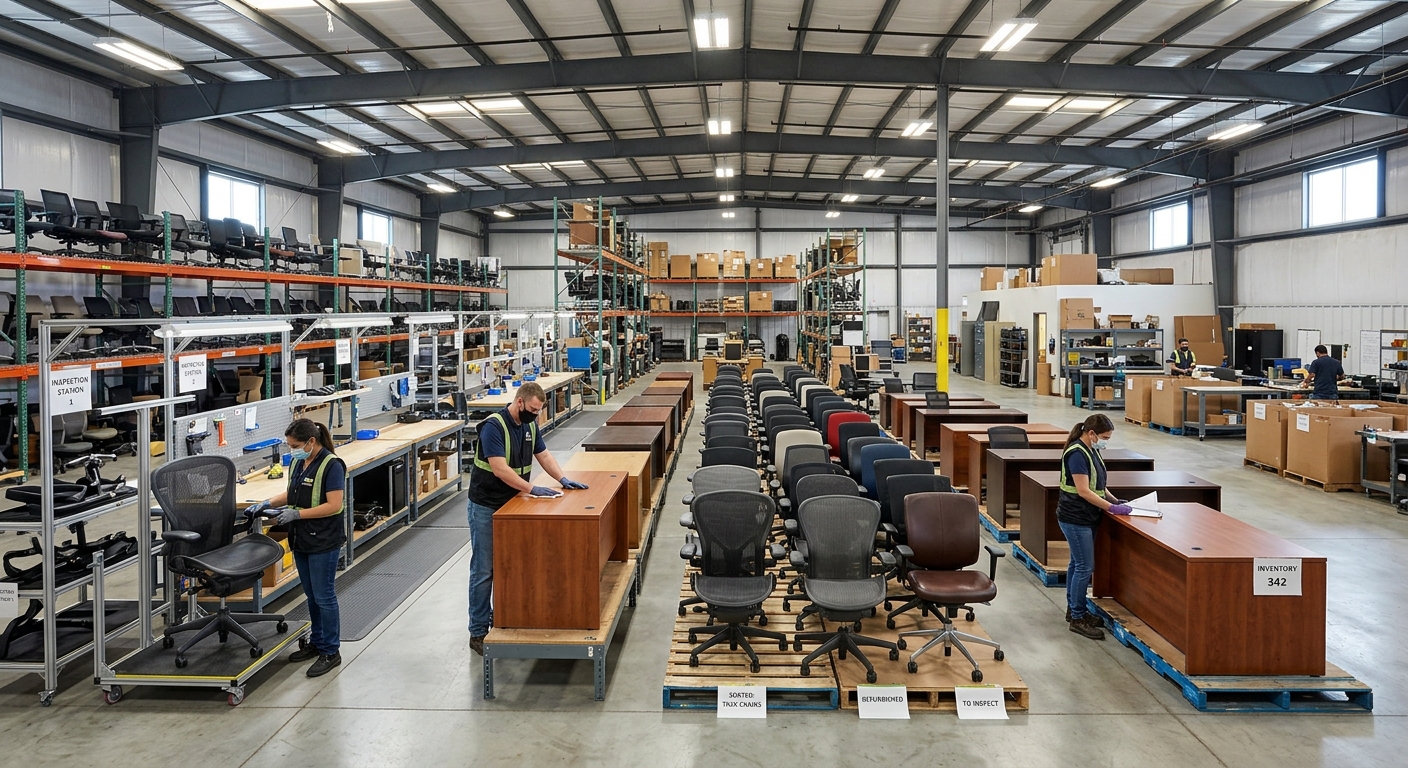
Circular sourcing means the vendor has a plan for the furniture before you’ve even placed the order — not just a plan for selling it to you. The strongest signal of a genuinely circular vendor is a take-back or buy-back program: they’ll reclaim the desks and chairs at end of lease or end of life and refurbish, resell, or responsibly break them down.
For example, a mid-size architecture firm refreshing its office every 5-7 years might negotiate a take-back clause directly into the purchase agreement — the vendor collects the old workstations, refurbishes the steel frames, and reupholsters the seating for resale into the used-furniture market. The firm gets a partial rebate, and roughly 60-70% of the furniture’s material weight avoids landfill entirely.
If you’re drafting vendor requirements, this is exactly the kind of clause worth including — see our guide on writing an office furniture RFP that gets you better vendor bids for language that pushes suppliers to commit to this in writing.
The Materials That Actually Hold Up Environmentally
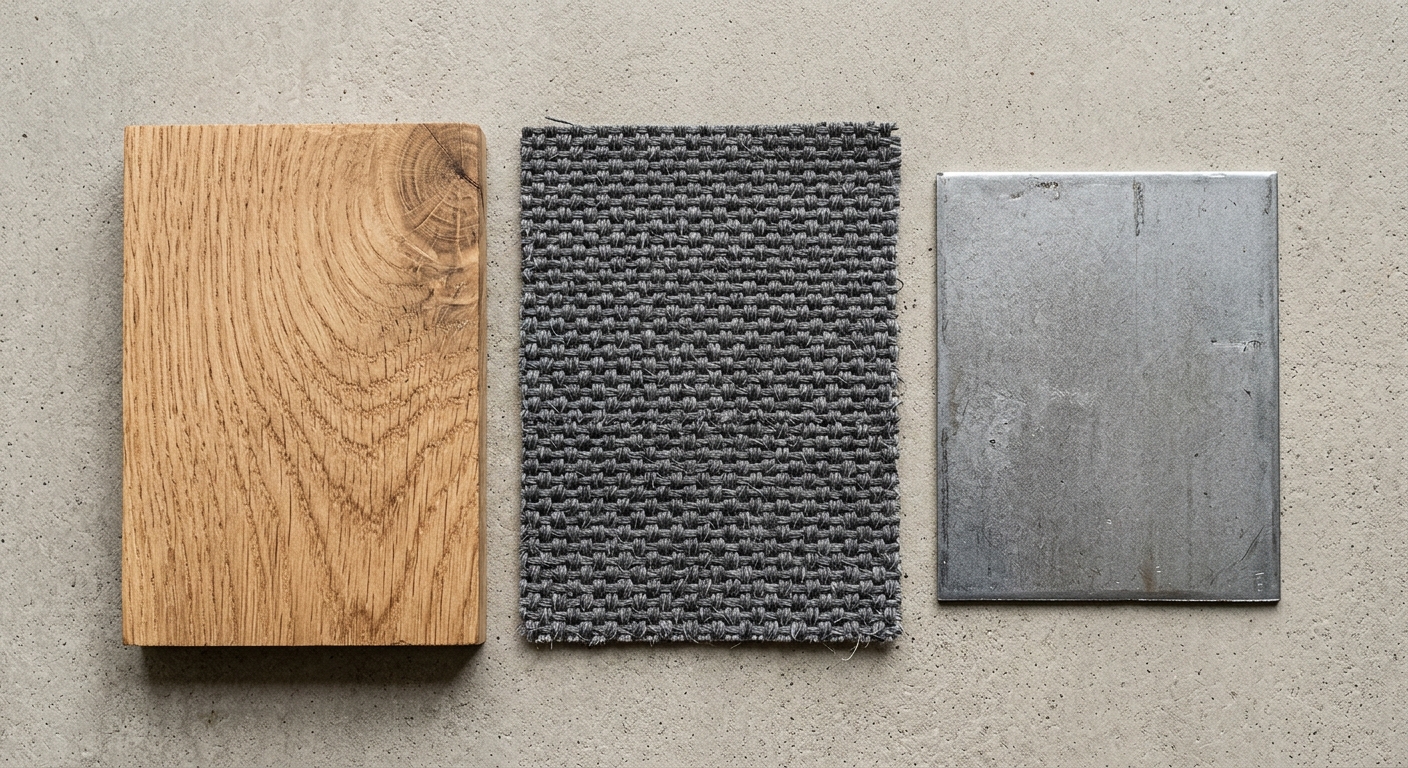
Not all ‘natural’ materials are equal, and not all synthetics are villains. Steel is the unsung hero of sustainable furniture — it’s infinitely recyclable without quality loss, and most manufacturers already use 30-90% recycled content in structural frames. Solid wood is genuinely durable and biodegradable at end of life, but only if it’s finished with low-VOC, non-plastic coatings; a wood desk sealed in polyurethane basically becomes a composite material.
The materials to be skeptical of
- Particleboard and MDF — cheap, common in budget desks, but the resin binders make them essentially unrecyclable and they off-gas formaldehyde for years. Related reading: why office furniture off-gasses and what to do about that new chair smell.
- Blended-fiber upholstery — a poly-cotton-spandex blend feels nice but can’t be recycled economically. Mono-material recycled PET mesh is the better long-term bet.
- Standard PU foam — degrades faster than people expect and almost never gets recycled. Compare cushion types in our breakdown of mesh vs. foam vs. hybrid seat cushions.
Certifications Worth Trusting (and the Ones That Are Mostly Marketing)
Not every green label means the same thing, and some are close to meaningless. BIFMA level certification actually audits material sourcing, energy use in manufacturing, and end-of-life recyclability across a weighted point system — that’s a certification worth asking for by name. GREENGUARD focuses specifically on chemical emissions, which matters for indoor air quality but says nothing about circularity.
Vague claims like ‘eco-conscious’ or ‘green materials’ printed on a spec sheet with no third-party audit behind them are essentially unverifiable marketing language. If a vendor can’t point you to a specific certification body and audit date, treat the claim as decorative, not factual.
Designing for Disassembly: What to Look for Before You Buy
Furniture designed for disassembly (DfD) uses mechanical fasteners instead of adhesives, standardizes screw types across a product line, and avoids mixed-material composites wherever structurally possible. It’s a design philosophy, and you can spot it in five minutes with a spec sheet or a showroom visit.
A quick field test
- Flip a chair over. Are the base, gas lift, and seat pan held with visible fasteners, or is everything molded as one piece?
- Ask the vendor: ‘If this breaks in year 6, can I replace just the part, or the whole unit?’ A good answer names specific replaceable components — casters, gas cylinders, armrests.
- Check whether the manufacturer publishes a parts catalog. If they do, that’s a strong circularity signal.
This same disassembly logic applies to desks and workstations, not just seating — our guide to selecting an efficient desk touches on modularity as a durability factor too.

What Happens If You Don’t Plan for End of Life
Roughly 8.5 million tons of office furniture ends up in U.S. landfills annually — a huge share of that is furniture that could have been refurbished or material-recovered but wasn’t, simply because nobody planned for it at purchase time. Once furniture is deep into a landfill, the cost and environmental impact of extraction dwarfs anything you’d have spent on a circular vendor upfront.
If your office is already sitting on aging furniture with no exit plan, it’s worth reading what happens to old office furniture — a practical guide to disposal, donation, and recycling before you default to a dumpster.
A Real-World Procurement Scenario
Consider a 200-person coworking operator renovating three locations over 18 months. Instead of buying new furniture outright for each site, they worked with a vendor offering refurbished steel-frame chairs (reupholstered locally) paired with new modular desks built with mechanically fastened components. Result: roughly 40% lower carbon footprint per workstation compared to all-new furniture, and a contractual buy-back clause for the next refresh cycle.
This kind of hybrid approach — mixing refurbished structural components with new soft goods — is increasingly common in coworking space furnishing, where turnover and durability both matter more than in a typical private office.
Questions to Ask Any Vendor Claiming to Be ‘Sustainable’
Skip the brochure and ask these directly:
- What percentage of this product’s weight is recyclable at end of life, and through what stream?
- Do you offer a take-back, refurbishment, or resale program?
- Which components are mechanically fastened vs. adhesive-bonded?
- What third-party certification backs your sustainability claims, and when was it last audited?
- What’s the expected functional lifespan before major components need replacement?
A vendor who answers all five with specifics is worth your business. One who deflects to ‘we care about the environment’ is not. Browse our own product range or furniture solutions to see how these answers should look in practice.
